Medical Disclaimer: This article is for informational purposes only and does not constitute medical advice. Always consult a licensed healthcare provider before starting, stopping, or changing any treatment for diabetes.
Managing diabetes no longer means spending hours in waiting rooms or paying $300 or more for a specialist visit. Virtual diabetes clinics have changed that.
Whether you’re newly diagnosed, uninsured, or just looking for more convenient care, you can now connect with physicians, dietitians, and certified diabetes educators — all from your phone or laptop.
But not all virtual diabetes clinics are equal. Some employ endocrinologists. Others offer only lifestyle coaching. Some cost $20 a month; others require employer coverage.
This guide breaks down the 7 best virtual diabetes clinics in 2026 — with real cost figures, what kind of care you actually get, and who each one is best suited for.
What Is a Virtual Diabetes Clinic?
A virtual diabetes clinic (also called a telehealth diabetes clinic or remote diabetes care program) connects people with diabetes to physicians, nurses, dietitians, or certified diabetes educators through video calls, messaging apps, and remote monitoring tools.
Unlike a general telemedicine platform where you see a different provider each time, virtual diabetes clinics typically offer ongoing, longitudinal care — the same care team follows your progress over weeks and months.
Some clinics can prescribe medications including metformin, SGLT2 inhibitors, GLP-1 agonists (like Ozempic and Mounjaro), and insulin. Others focus only on lifestyle coaching and cannot prescribe.
Knowing the difference before you sign up matters.
How We Evaluated These Virtual Diabetes Clinics
We assessed each clinic on six criteria:
- Physician access — Can a licensed MD prescribe medications, or is it coaching only?
- Cost — Monthly fee, per-visit charges, and what’s included
- Insurance requirements — Self-pay options versus employer/insurer-only access
- States covered — National vs. limited availability
- Care type — Reversal-focused, management, behavioral, or specialist-led
- Evidence base — Published clinical outcomes or peer-reviewed data
Quick Comparison: Best Virtual Diabetes Clinics
| Clinic | Monthly Cost | Physicians | Insurance Required | Best For |
|---|---|---|---|---|
| Virta Health | Employer-covered | Yes (MD) | Usually | T2D reversal |
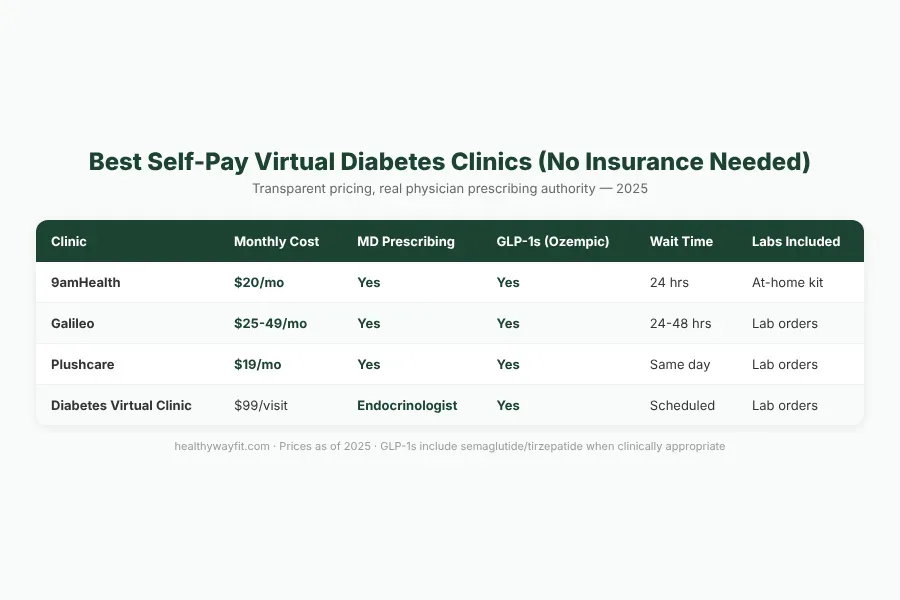
| 9amHealth | From $20/mo | Yes (MD) | No | Self-pay / uninsured |
| Galileo | $49/mo | Yes (MD) | No | Full prescribing |
| Omada Health | Employer-covered | Yes (MD + CDCES) | Usually | Evidence-based coaching |
| Diabetes Virtual Clinic | $99/visit | Yes (Endocrinologist) | No | Specialist access |
| Teladoc Health | Free via employer | Yes (coaching+) | Usually | Employer-covered |
| Plushcare | From $19/mo | Yes (MD) | No | Fast physician access |
7 Best Virtual Diabetes Clinics in 2026
1. Virta Health — Best for Type 2 Diabetes Reversal
Virta Health is a physician-supervised remote care program focused on reversing type 2 diabetes through a very low-carbohydrate (ketogenic) nutrition protocol combined with continuous physician and health coaching support.
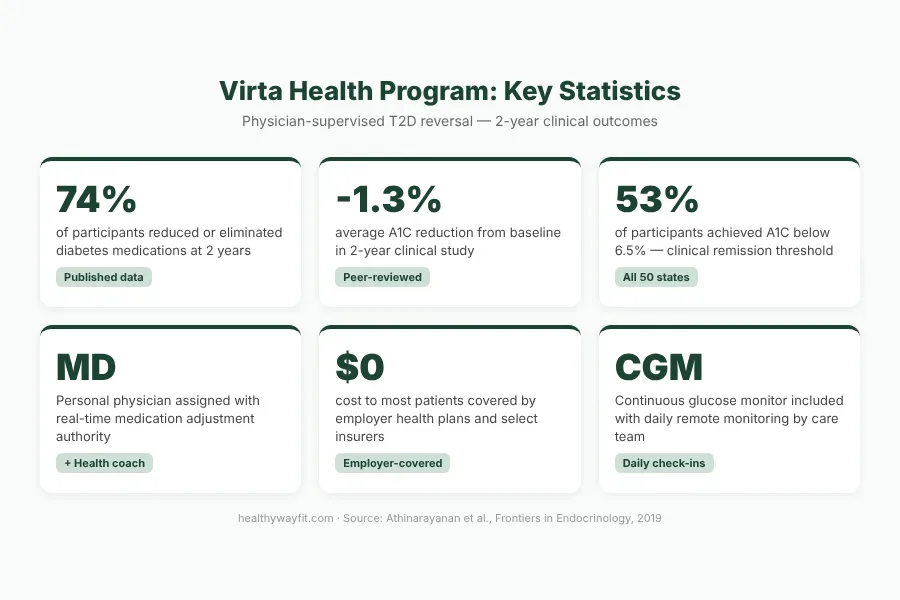
How it works: You’re assigned a personal physician and health coach who monitor your blood glucose, ketone levels, and biometrics remotely. The program uses continuous glucose monitoring (CGM) and daily app check-ins. Physicians adjust medications in real time — and many patients reduce or eliminate diabetes medications within months.
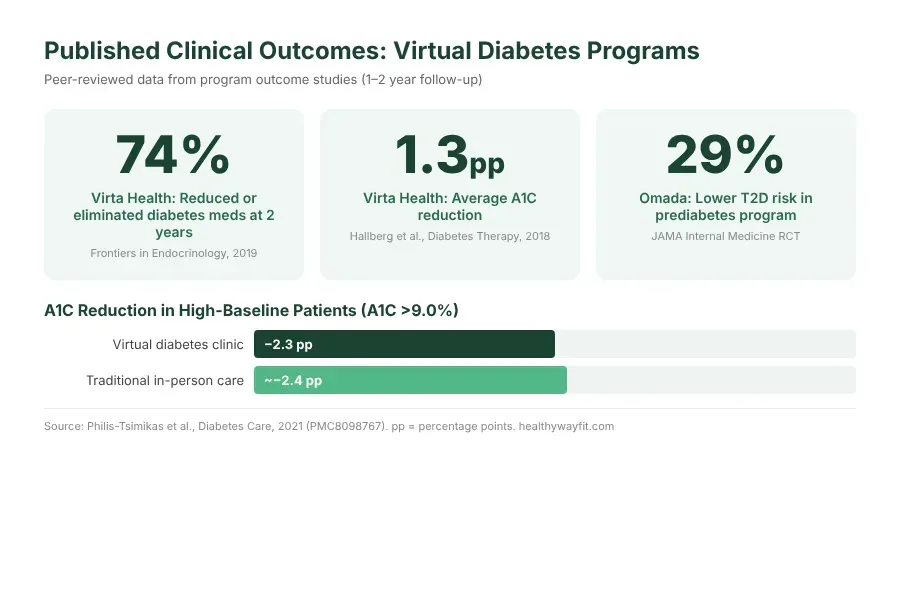
Clinical outcomes: A study published in Frontiers in Endocrinology found that at 2 years, 74% of Virta patients reduced or eliminated diabetes medications, and average A1C dropped by 1.3 percentage points. Notably, 53% of patients achieved A1C below 6.5% — the clinical threshold for diabetes remission.
Cost: Virta Health primarily works through employers and health insurers. If your employer covers it, your cost may be $0 or a small copay.
Who it’s best for: People with type 2 diabetes whose primary goal is reversal or significant A1C reduction — and who are willing to commit to a low-carb protocol with daily check-ins.
Availability: All 50 U.S. states.
Pros: Strongest published evidence for T2D reversal; physician-supervised medication adjustment; CGM included
Cons: Requires employer/insurer coverage for most people; dietary protocol is strict; not suitable for those who just want medication management
2. 9amHealth — Best Self-Pay Virtual Diabetes Clinic
9amHealth is a virtual diabetes clinic designed specifically for people with type 2 diabetes and prediabetes who want physician-led care without needing insurance.
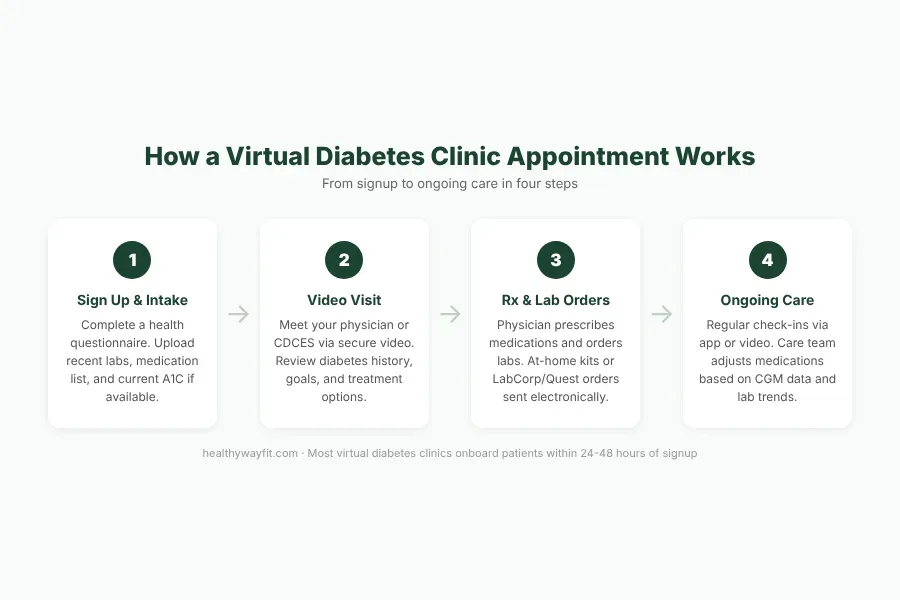
How it works: After signing up, you can see a licensed physician for a video visit within 24 hours. The care team includes physicians, dietitians, and health coaches. At-home lab kits are available — no lab visit required.
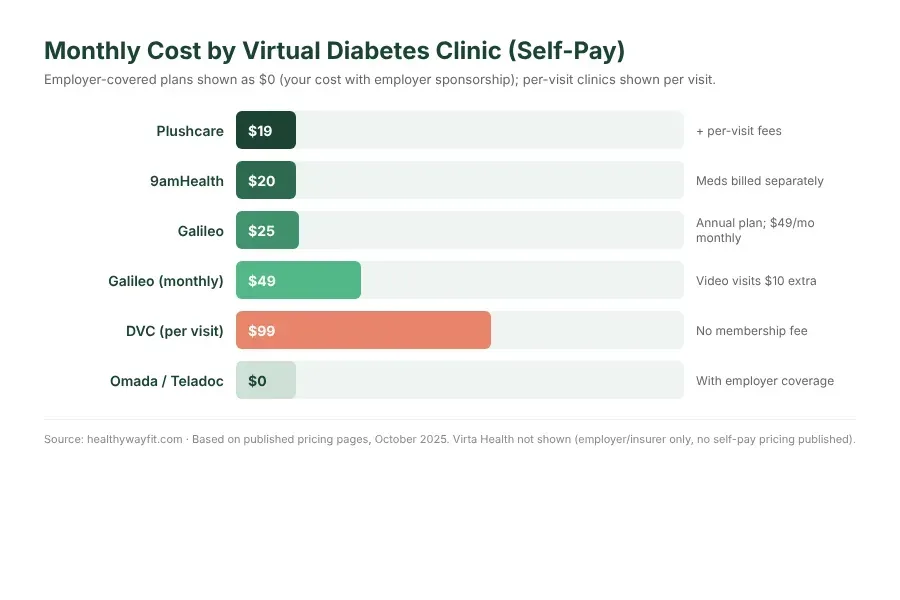
Cost: Plans start at $20/month for the core program. Medications are billed separately. They accept most major insurance plans but also offer transparent self-pay pricing.
Who it’s best for: The uninsured or underinsured who need affordable, physician-led diabetes care with real prescribing authority — not just coaching. Physician access within 24 hours is a standout feature.
Availability: Available in most U.S. states.
Pros: No insurance required; fast physician access; at-home labs; competitive pricing
Cons: Medications billed separately; newer service with less published clinical data than Virta or Omada
3. Galileo — Best for Comprehensive Medication Management
Galileo is a full-service telehealth platform staffed by board-certified physicians who can prescribe the full spectrum of diabetes medications — including SGLT2 inhibitors, GLP-1 agonists (Ozempic, Mounjaro), and insulin.
How it works: Members pay a flat monthly or annual fee and get 24/7 access to their care team via chat and video. A physician develops a personalized diabetes management plan, prescribes as needed, and monitors progress ongoing.
Cost: $49/month or $299/year (about $25/month billed annually). Video visits are $10 each on top of membership. They accept most major insurance plans.
Who it’s best for: People who want full prescribing access — especially to newer diabetes medications like GLP-1 agonists — without the $300+ cost of seeing an in-person endocrinologist.
Availability: Nationwide.
Pros: Flat-fee pricing; full prescribing including GLP-1s and insulin; 24/7 care team access
Cons: Video visits cost extra; not specialized exclusively in diabetes
4. Omada Health — Best Evidence-Based Behavioral Program
Omada Health is a digital therapeutics company whose diabetes prevention and management programs are among the most rigorously studied virtual programs in the U.S.
How it works: Members get a dedicated CDCES (Certified Diabetes Care and Education Specialist) coach, a cellular-enabled smart scale, and access to a physician who can prescribe medications including GLP-1s. The program emphasizes sustained behavior change — food, movement, sleep, and stress — alongside medication when appropriate.
Clinical outcomes: Omada’s diabetes prevention program is CDC-recognized. A randomized controlled trial published in JAMA Internal Medicine found participants had a 28.9% lower risk of developing type 2 diabetes compared to controls.
Cost: Omada primarily serves employer and health plan populations. If your employer covers it, cost is typically $0.
Who it’s best for: Employees whose company offers Omada, particularly those with prediabetes or early T2D who want a behavioral-first, evidence-based approach.
Pros: Strongest evidence base for prediabetes; CDCES coaches; CDC-recognized program; physician prescribing available
Cons: Typically requires employer/insurer; primarily behavioral (not specialist-led)
5. Diabetes Virtual Clinic — Best for Endocrinologist Access
Diabetes Virtual Clinic connects patients directly with board-certified endocrinologists — not general practitioners or health coaches — for comprehensive virtual diabetes care.
How it works: You schedule a video appointment with an endocrinologist who reviews your full medical history, current medications, labs, and glucose data. The endocrinologist can prescribe or adjust any diabetes medication and order labs. CGM setup and training is also available.
Cost: $99 per video visit. No membership fee. They do not currently accept insurance, so all visits are self-pay.
Who it’s best for: Anyone who needs true endocrinologist expertise — complex cases, insulin-dependent patients, those on multiple diabetes medications, or anyone not responding to standard care.
Availability: All 50 U.S. states.
Pros: True endocrinologist access; no membership fee; nationwide coverage; CGM support
Cons: No insurance accepted (fully out-of-pocket); per-visit model with no ongoing program structure
6. Teladoc Health — Best If You Already Have Coverage
Teladoc Health is one of the largest telehealth networks in the U.S. Its diabetes management program (formerly Livongo) is available to millions through employer and health plan benefits.
How it works: The diabetes program provides a smart blood glucose meter, unlimited test strips, coaching, and access to a care team. Physicians are available for video visits for members who need prescriptions. The platform integrates with Apple Health and other apps.
Important note: The Teladoc diabetes management program is primarily coaching-based. Physician prescribing is available but not the core offering. If your primary need is medication management, confirm your plan includes the physician tier.
Cost: Typically free or low-cost through employer or health insurer.
Who it’s best for: Employees who already have Teladoc through work and want convenient app-based diabetes support with a smart glucose meter and coaching.
Pros: Often $0 through employer; smart meter included with unlimited strips; large established network
Cons: Primarily coaching, not physician-led; requires employer/insurer coverage; limited self-pay
7. Plushcare — Best for Fast Physician Access
Plushcare is a direct-pay telehealth platform where board-certified physicians can evaluate and prescribe for diabetes — including metformin, SGLT2 inhibitors, and GLP-1s — with same-day or next-day appointments.
How it works: You book a 15–30 minute video visit with a physician. After evaluation, the physician prescribes diabetes medications and orders labs. Unlike specialty diabetes programs, Plushcare is a general telehealth platform — but it’s practical for people who need quick physician access for a prescription refill or new treatment start.
Cost: Membership starts at $19/month, which includes one free visit. Additional visits are billed at the visit rate. They accept most major insurance plans.
Who it’s best for: People who need fast physician access and a prescription without the cost of in-person care, but don’t need a full diabetes program.
Pros: Same-day appointments often available; full prescribing; accepts insurance; low monthly fee
Cons: General platform (not diabetes-specialized); no embedded CDCES coaching
What Makes a Good Virtual Diabetes Clinic?
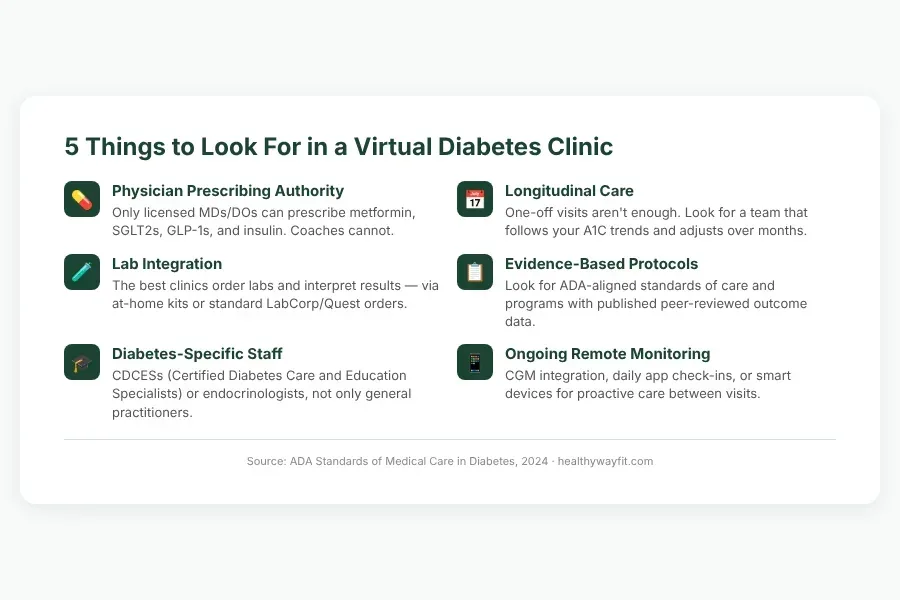
Not every telehealth platform that mentions “diabetes” qualifies as a virtual diabetes clinic. Here’s what to look for:
Physician prescribing authority. Coaches and educators can’t write prescriptions. If you need metformin, GLP-1s, SGLT2 inhibitors, or insulin adjustments, you need a licensed MD or DO with prescribing authority in your state.
Longitudinal care. A one-off visit is useful, but managing diabetes requires someone following your A1C trends, medication adjustments, and lab values over months. Look for programs with ongoing care teams.
Lab integration. The best virtual clinics can order labs and interpret results — either through at-home kits or standard lab orders sent to your nearest LabCorp or Quest.
Evidence-based protocols. Ask whether the program follows ADA (American Diabetes Association) standards of care. Programs with published peer-reviewed outcomes data are preferable.
Diabetes-specific staff. Look for programs with CDCESs (Certified Diabetes Care and Education Specialists) or endocrinologists, not just general practitioners.
Virtual Diabetes Care vs. In-Person Care
Research suggests virtual diabetes care can be as effective as in-person care for most patients. A 2021 study involving 740 adults with type 2 diabetes found that those with baseline A1C above 9.0% experienced a 2.3 percentage point reduction in A1C through a virtual diabetes clinic — comparable to results seen in traditional clinical settings.
The main advantages of virtual care: convenience, lower cost, higher frequency of touchpoints (you can message your care team daily), and accessibility for people in rural areas or those with mobility limitations.
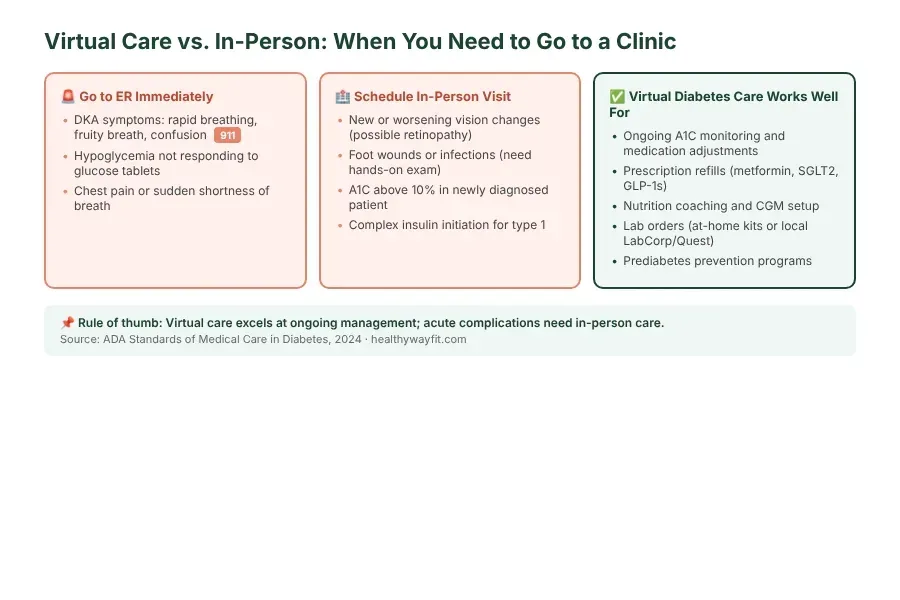
The main limitations: virtual clinics cannot perform physical exams, administer infusions, or handle acute complications like diabetic ketoacidosis (DKA). They may also not be the right fit for very complex insulin-dependent patients who need frequent in-office testing.
When to See a Doctor in Person
Virtual care excels at ongoing management — but there are situations where in-person evaluation is medically necessary:
- Symptoms of diabetic ketoacidosis (DKA): Rapid breathing, fruity-smelling breath, nausea/vomiting, confusion — go to the ER immediately
- Hypoglycemia not responding to treatment: If blood sugar stays dangerously low despite eating glucose tablets
- New or worsening vision changes: May indicate diabetic retinopathy requiring in-person ophthalmology
- Foot wounds or infections: Diabetic foot complications require hands-on examination
- Chest pain or shortness of breath: Rule out cardiovascular complications
- A1C above 10% in a newly diagnosed patient: Complex medication initiation often benefits from in-person evaluation
If you experience any of the above, contact your nearest emergency department or call 911. Do not wait for a virtual appointment.
Frequently Asked Questions
Can a virtual diabetes clinic prescribe Ozempic or Mounjaro?
Yes — if the clinic includes physicians with prescribing authority. Galileo, 9amHealth, Plushcare, Virta Health, and Omada Health all offer physician access and can prescribe GLP-1 medications like semaglutide (Ozempic/Wegovy) and tirzepatide (Mounjaro/Zepbound) when clinically appropriate. Note that supply and insurance coverage vary.
Is virtual diabetes care covered by insurance?
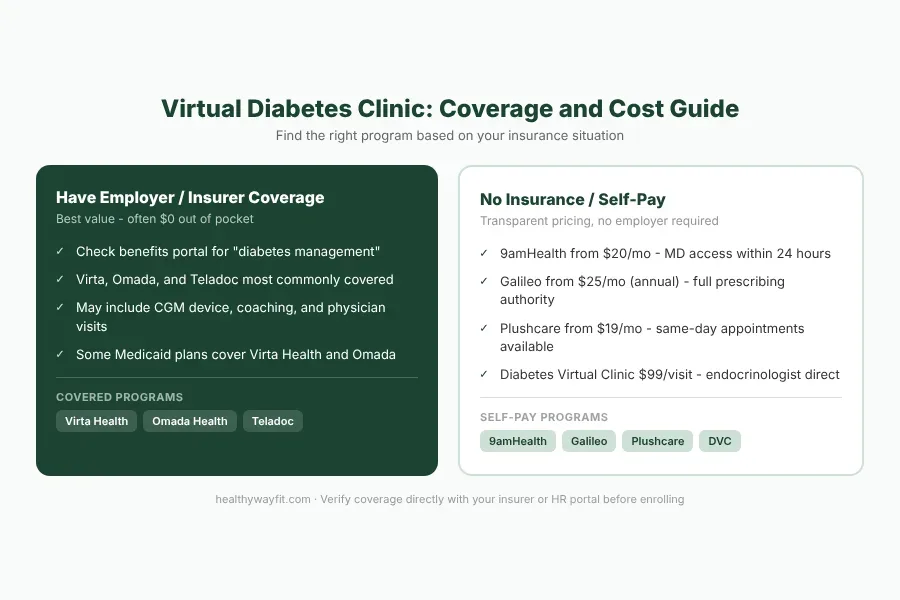
It depends on your insurer and plan. Virta Health and Omada Health are covered by many employer health plans and some Medicaid plans. For a plan-by-plan breakdown, see our guide: Does Insurance Cover Diabetes Reversal Programs? Teladoc is covered by most employer plans. For self-pay with transparent pricing, 9amHealth and Galileo are the most accessible options. For a full breakdown by plan type, see our guide on whether insurance covers diabetes reversal programs.
Can I reverse type 2 diabetes through a virtual clinic?
Reversal — defined as achieving A1C below 6.5% without medication — is possible for some people, particularly those with shorter diabetes duration and significant weight to lose. Virta Health has the strongest published evidence for diabetes reversal. Learn more in our guide: Is Type 2 Diabetes Reversible? | 7 Best Online Prediabetes Reversal Programs
What’s the cheapest virtual diabetes clinic?
For self-pay patients, Plushcare starts at $19/month and 9amHealth at $20/month. Galileo’s annual plan works out to about $25/month. If your employer covers Teladoc or Omada, those may be free. You can also use HSA or FSA funds to cover out-of-pocket costs at eligible programs — see which diabetes programs qualify for HSA reimbursement.
Do virtual diabetes clinics prescribe insulin?
Yes — Galileo, Diabetes Virtual Clinic, 9amHealth, and Plushcare can all prescribe insulin when appropriate. Virta Health’s program typically reduces insulin dependency rather than initiating it, as part of their reversal protocol.

The Bottom Line
The best virtual diabetes clinic depends on your specific situation:
- Need reversal-focused care and have employer coverage? Go with Virta Health.
- Uninsured or want self-pay options? 9amHealth or Galileo are your best bets.
- Want endocrinologist expertise? Diabetes Virtual Clinic at $99/visit.
- Prefer an evidence-based behavior-change program? Omada Health (if employer-covered).
- Need quick physician access and a prescription? Plushcare.
- Already covered through work? Check if Teladoc is included.
Whatever route you take, consistent, ongoing care matters more than any single choice. Diabetes managed remotely is dramatically better than diabetes not managed at all.
Not sure where to start? Our free diabetes management training walks you through the foundational steps before choosing a program.
Also see: Best Diabetes Programs Without Insurance | What Is HbA1c? | Is Type 2 Diabetes Reversible? | HSA Eligible Diabetes Programs
Sources
- Athinarayanan SJ, et al. “Long-Term Effects of a Novel Continuous Remote Care Intervention Including Nutritional Ketosis for the Management of Type 2 Diabetes.” Frontiers in Endocrinology. 2019. https://doi.org/10.3389/fendo.2019.00348
- Hallberg SJ, et al. “Effectiveness and Safety of a Novel Care Model for the Management of Type 2 Diabetes at 1 Year.” Diabetes Therapy. 2018. https://doi.org/10.1007/s13300-018-0373-9
- Philis-Tsimikas A, et al. “Virtual clinic for diabetes management: effectiveness outcomes.” Diabetes Care. 2021 (PMC8098767).
- Sepah SC, et al. “Long-term outcomes of a Web-based diabetes prevention program.” J Med Internet Res. 2015. https://doi.org/10.2196/jmir.4052
- American Diabetes Association. “Standards of Medical Care in Diabetes — 2024.” Diabetes Care. 2024. https://doi.org/10.2337/dc24-SINT
- Centers for Disease Control and Prevention. “CDC-Recognized Diabetes Prevention Programs.” cdc.gov. 2024.
- Omada Health. “Omada for Diabetes Prevention — Clinical Evidence.” omadahealth.com. 2023.
- Faruque LI, et al. “Effect of telemedicine on glycated hemoglobin in diabetes: a systematic review and meta-analysis.” BMJ. 2017. https://doi.org/10.1136/bmj.j5471
- Azar KMJ, et al. “Disparate Use of Digital Health Tools in Racial/Ethnic Groups.” JAMA Network Open. 2020. https://doi.org/10.1001/jamanetworkopen.2020.20381
- Garg SK, et al. “Continuous Glucose Monitoring in Type 2 Diabetes: Systematic Review.” Diabetes Technology & Therapeutics. 2021.