By Kirti, Founder & Serial Entrepreneur, HealthyWayFit | Reviewed by our medical and compliance team
Last updated: October 2026
Disclaimer: This article is for informational purposes only and does not constitute medical, financial, or tax advice. Always consult a qualified healthcare professional before making changes to your diabetes management plan, and speak with a tax professional or your HSA plan administrator about eligibility questions specific to your situation.
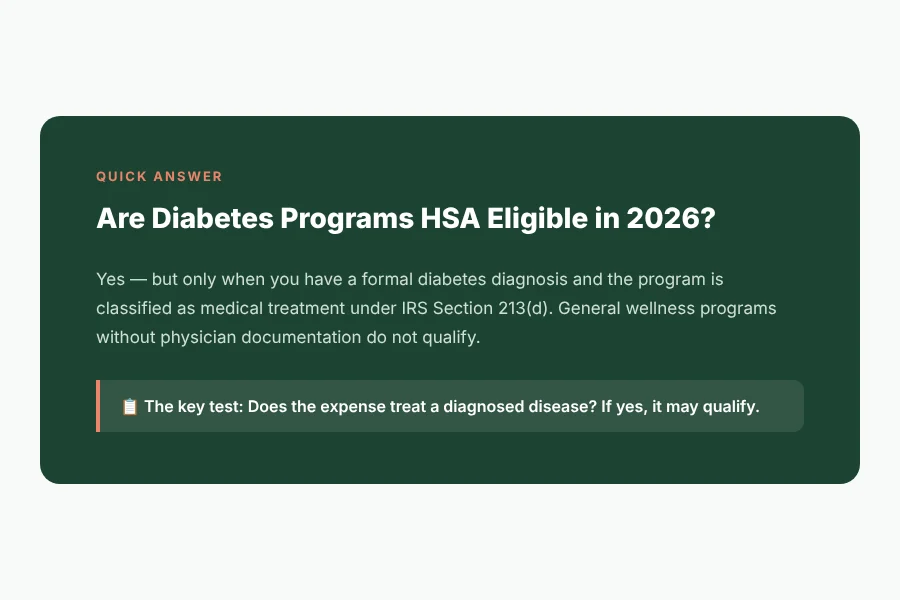
A diabetes program may be eligible for your Health Savings Account — but whether yours qualifies depends on a single IRS rule. Programs that treat a documented, diagnosed disease qualify. General wellness programs typically do not. Read on to find out exactly which diabetes programs and supplies count in 2026, and how to use your HSA card or request reimbursement.
What Is an HSA and How Does It Work in 2026?
A Health Savings Account (HSA) is a tax-advantaged account available to people enrolled in a qualifying High-Deductible Health Plan (HDHP). Contributions are tax-deductible, the money grows tax-free, and withdrawals for qualified medical expenses are also tax-free — a triple tax advantage.
The IRS set higher contribution limits for 2026. Individuals can contribute up to $4,400, and families up to $8,750 per year. To open and contribute to an HSA, your HDHP must meet a minimum deductible of $1,700 (individual) or $3,400 (family), with an out-of-pocket maximum of $8,500 (individual) or $17,000 (family), according to IRS guidance reported by Lockton.

Unlike a Flexible Spending Account (FSA), HSA funds roll over year to year. Once you turn 65, you can withdraw for any purpose without penalty — though non-medical withdrawals become taxable income.
If you have been managing type 2 diabetes and want to understand what a science-backed approach looks like before committing to any paid program, HealthyWayFit’s free training covers the core framework at no cost.
The Rule That Decides Everything: IRS Section 213(d)
The eligibility test for any HSA expense is whether it qualifies under IRC Section 213(d), which defines “medical care” as amounts paid for the diagnosis, cure, mitigation, treatment, or prevention of disease. The IRS elaborates in Publication 502 (Medical and Dental Expenses) and Publication 969 (HSAs and Other Tax-Favored Health Plans).
According to IRS FAQs on nutrition and wellness expenses:
- Nutritional counseling is HSA-eligible only when it treats a specific disease diagnosed by a physician — diabetes is explicitly given as a qualifying example.
- Weight-loss programs are HSA-eligible only when they treat a diagnosed condition such as obesity, diabetes, or hypertension.
- General wellness programs do not qualify unless they are prescribed to treat a specific diagnosed disease.

The practical rule: if you have a documented diabetes diagnosis, many structured diabetes programs may qualify. Without a formal diagnosis, general health and wellness spending does not.
Diabetes Supplies That Are Always HSA Eligible
Certain diabetes-related items qualify without ambiguity, according to IRS Publication 502 and Doctronic’s HSA/FSA diabetes supplies guide:
- Continuous glucose monitors (CGMs) and replacement sensors and transmitters (when prescribed) — also treated as preventive care for HDHP purposes per IRS Notice 2024-75
- Blood glucose meters, test strips, lancets and control solutions
- Insulin in all formulations (rapid-, intermediate- and long-acting)
- Insulin pumps and related supplies (infusion sets, reservoirs, insertion devices)
- Other prescribed diabetes medications such as metformin
- Diabetic shoes and custom orthotics prescribed for diabetes-related foot complications
- Eye exams for diabetic retinopathy and recommended corrective devices

Pay for these directly with your HSA debit card, or pay out of pocket and submit a reimbursement claim. Keep all receipts and prescription records — the IRS may ask you to substantiate these expenses.
Can You Use Your HSA for a Diabetes Management Program?
Structured diabetes programs — coaching, education, remote monitoring, or intensive lifestyle programs — occupy a grey zone. Eligibility depends on three factors:
- Whether you have a documented diabetes diagnosis from a licensed healthcare provider
- Whether the program is delivered as medical treatment rather than general wellness
- Whether your HSA plan administrator approves the expense under their interpretation of Section 213(d)
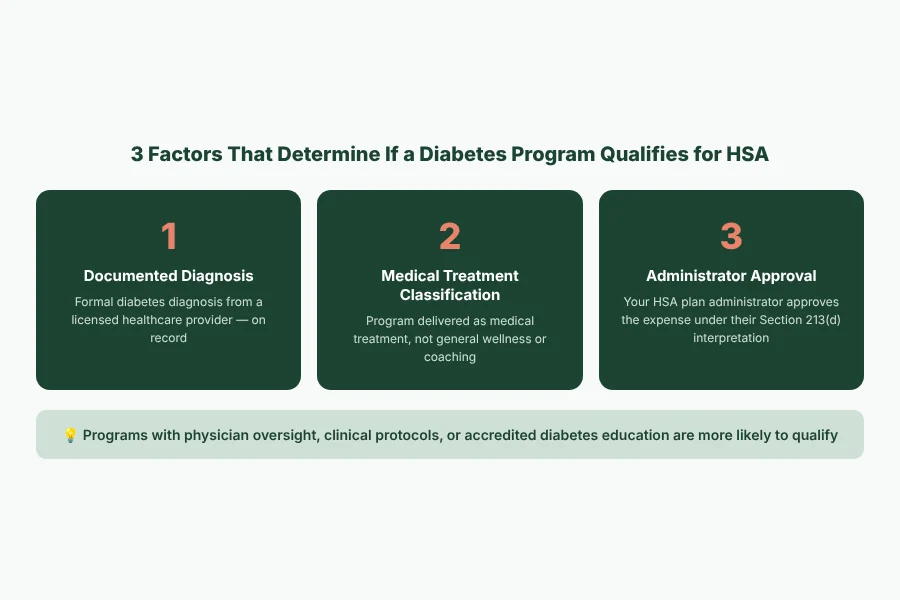
Programs with physician oversight, clinical protocols, or accredited diabetes education are more likely to qualify than apps or general coaching services.
Which Diabetes Programs May Qualify for HSA Payment?
Virta Health
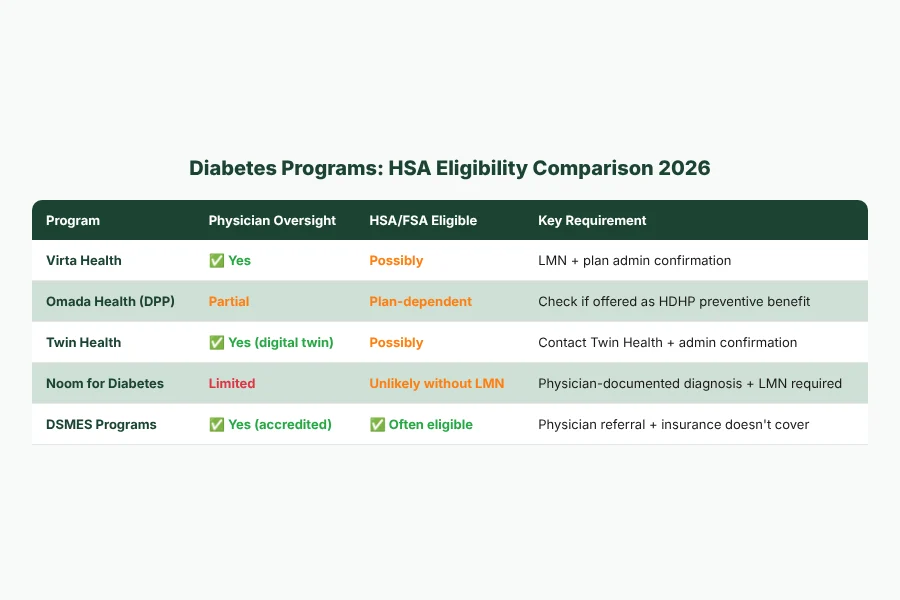
Virta Health is a physician-supervised type 2 diabetes reversal program using nutritional ketosis and continuous remote care. According to Virta’s official eligibility information, members who have plan cost-sharing may be able to use HSA or FSA funds. Most members access Virta through their employer or insurance plan at low or no out-of-pocket cost.
If you pay out of pocket, a Letter of Medical Necessity from your doctor may allow HSA reimbursement — confirm with your plan administrator first. For a breakdown of Virta’s costs, see our guide to Virta Health’s pricing without insurance. For an independent assessment, read our Virta Health reviews summary.
If you are also comparing insurance coverage options for these programs, our guide on whether insurance covers diabetes reversal programs breaks down Medicare, employer plans, and Medicaid coverage in detail.
Twin Health
Twin Health provides a whole-body digital twin approach to type 2 diabetes management, integrating CGM data with human coaching. It is primarily distributed through employers and health plans. Individual payment options and HSA eligibility vary by plan — contact Twin Health directly and confirm with your HSA administrator.
Omada Health
Omada Health offers a CDC-recognized Diabetes Prevention Program (DPP) and a type 2 diabetes management program. DPP programs offered as a preventive benefit through an HDHP may be covered before the deductible. Individual out-of-pocket enrollment eligibility through HSA depends on your specific plan.
Noom for Diabetes
Noom’s diabetes-focused coaching is primarily classified as a wellness program. Weight-loss and lifestyle programs generally require a physician-documented diagnosis and a Letter of Medical Necessity to qualify under Section 213(d). Without that documentation, Noom is unlikely to be HSA-reimbursable.
For a full comparison of programs, see our guide to the best online diabetes reversal programs.
Diabetes Education Programs (DSMES) and HSA
Diabetes Self-Management Education and Support (DSMES) is a structured, accredited education service that helps people with diabetes manage their condition day-to-day. The CDC’s DSMES background page outlines its evidence base and standard delivery.

DSMES is often covered by insurance first. Medicare covers up to 10 hours annually when a physician refers you. If your insurance plan does not cover DSMES, FSA or HSA funds may apply, since DSMES meets the criteria for eligible medical services when a physician referral is in place.
To pay for DSMES with your HSA:
- Ask your doctor for a referral and a Letter of Medical Necessity
- Confirm with your HSA administrator that DSMES qualifies under your plan
- Pay with your HSA card, or pay out of pocket and submit a reimbursement claim with your documentation
How to Use Your HSA for a Diabetes Program: Step by Step
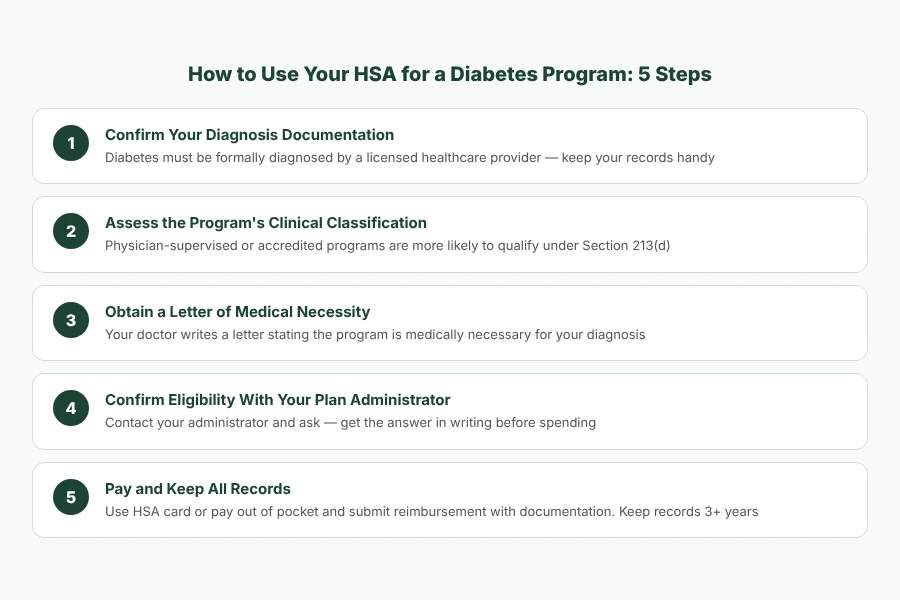
Step 1 — Confirm your diagnosis documentation. Your diabetes diagnosis must be formally documented by a licensed healthcare provider. Keep records of your diagnosis date and the treating physician’s contact details.
Step 2 — Assess the program’s clinical classification. Is the program physician-supervised, medically supervised, or an accredited diabetes education service? Programs with a clinical component are more likely to qualify under Section 213(d).
Step 3 — Obtain a Letter of Medical Necessity. Ask your doctor to write a letter stating that the diabetes program is medically necessary for your diagnosed condition. This document is your best protection if an HSA administrator questions the expense.
Step 4 — Confirm eligibility with your HSA plan administrator. Before spending, contact your administrator and ask: “Is [specific program name] an eligible expense under my plan’s interpretation of IRS Section 213(d)?” Get the answer in writing.
Step 5 — Pay and keep your records. Pay with your HSA debit card or pay out of pocket and submit a reimbursement claim with your receipt and supporting documentation. The IRS recommends keeping records for at least three years.
What a Letter of Medical Necessity Can Unlock
A Letter of Medical Necessity (LMN) is a document from your physician stating that a specific service is medically necessary for your diagnosed condition. Under IRS Publication 502, expenses that would not ordinarily qualify may become eligible when proper documentation ties the service to treating a diagnosed disease.
A strong LMN should include:
- Your name and date of birth
- Your documented diagnosis (type 2 diabetes, prediabetes with clinical intervention, insulin resistance)
- The specific program or service being recommended
- The medical rationale for why it is necessary for your condition
- Your physician’s signature, credentials and practice contact information

Not all HSA administrators accept LMNs for the same expenses. Always confirm with your administrator before assuming the expense will be reimbursed.
HSA vs FSA: Which Is Better for Diabetes Program Spending?
Both Health Savings Accounts (HSAs) and Flexible Spending Accounts (FSAs) use pre-tax dollars for qualified medical expenses, and the same Section 213(d) rules govern both. The key differences:
HSA advantages: Full balance rollover every year; account belongs to you if you change employers; higher 2026 individual limit ($4,400 vs $3,300 for FSA); usable investment account after 65.
FSA advantage: Not limited to HDHP enrollment — available with most employer health plans.
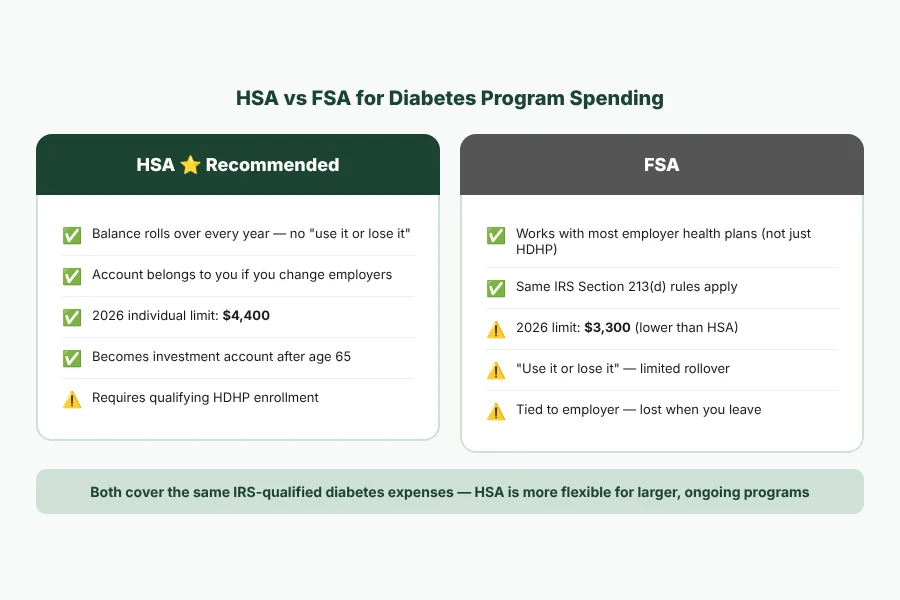
If you have a choice between the two and are enrolled in an HDHP, the HSA is generally more flexible for larger, ongoing diabetes program expenses because your balance builds year over year. If your employer offers only an FSA, it still covers the same IRS-qualified diabetes expenses.
What Diabetes-Related Expenses Are NOT HSA Eligible
Some commonly assumed expenses do not qualify:
- General gym memberships (unless prescribed in writing to treat a specific diagnosed disease)
- Dietary supplements and vitamins (not eligible unless a physician prescribes them to treat a documented deficiency condition)
- Food and beverages marketed as “diabetes-friendly” (do not qualify as medical expenses)
- General wellness coaching apps without a clinical component or physician documentation
- Health insurance premiums (with limited exceptions: COBRA continuation coverage, Medicare Part B and D after age 65, and coverage received while on unemployment compensation)
If you are looking for programs that may work without insurance, our comparison of best diabetes programs without insurance covers pricing and access options in detail.
When to Talk to a Healthcare Professional
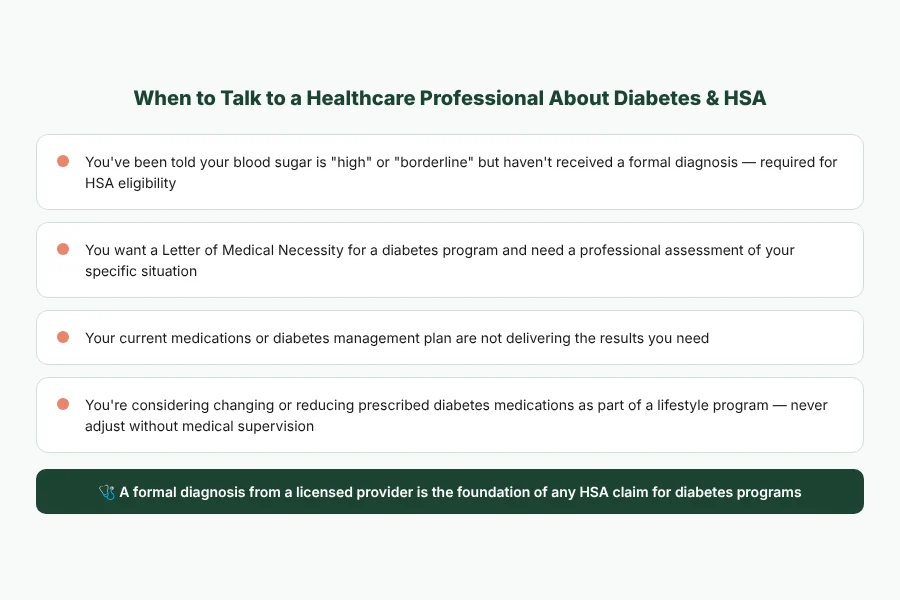
Consider speaking with a doctor or endocrinologist if:
- You have been told your blood sugar is “high” or “borderline” but have not received a formal diagnosis — a documented diagnosis is essential for HSA eligibility
- You want a Letter of Medical Necessity for a diabetes program and need a professional assessment of your specific situation
- Your current medications or diabetes management plan are not delivering the results you need
- You are considering changing or reducing prescribed diabetes medications as part of a lifestyle program — never adjust medications without medical supervision
Frequently Asked Questions
Can I use my HSA card directly at enrollment for a diabetes program? Many programs accept HSA debit cards as a standard payment method. If yours does not, pay out of pocket and submit a reimbursement claim to your HSA administrator with receipts and your Letter of Medical Necessity.
Does a diabetes program need to be accredited to qualify? Accreditation (such as ADA or AADE recognition) strengthens your case with an HSA administrator, but it is not an IRS requirement. The key test is Section 213(d): does the expense treat a diagnosed disease? Physician documentation adds further support.
Can I use HSA funds for a diabetes reversal program? If the program includes clinical supervision and you have a documented diabetes diagnosis, it may qualify under Section 213(d). Always confirm eligibility with your HSA plan administrator before spending, and obtain a Letter of Medical Necessity from your doctor.
What if my HSA administrator denies my claim? You have the right to appeal. Submit your LMN, diagnosis documentation and a written explanation of how the expense meets Section 213(d). Many administrators have a formal appeals process. A tax professional can advise on IRS-level disputes if the issue is not resolved.
Are CGMs always HSA eligible regardless of program enrollment? Yes. CGMs prescribed for diabetes management are eligible HSA expenses. Per IRS Notice 2024-75, CGMs for people with a diabetes diagnosis are also treated as preventive care for HDHP purposes, meaning they may be covered before the deductible is met.
The Bottom Line
A diabetes program may be HSA eligible if it treats your documented diabetes diagnosis and your plan administrator approves the expense. Start with your formal diagnosis, choose a program with clear clinical oversight, and get a Letter of Medical Necessity from your doctor before spending.
The best next step is understanding what a science-backed diabetes management approach actually involves before you pay for any program. HealthyWayFit’s free training gives you the foundational framework — and the questions to ask your doctor and HSA administrator.
Sources
- IRS Publication 969: HSAs and Other Tax-Favored Health Plans (2025) — Internal Revenue Service
- IRS Publication 502: Medical and Dental Expenses — Internal Revenue Service
- IRC Section 213(d): Definition of Medical Care — Internal Revenue Code
- IRS FAQs: Nutrition, Wellness and General Health Expenses — via NFP
- IRS Notice 2024-75: CGMs as Preventive Care for HDHP Purposes — Internal Revenue Service
- 2026 HSA Contribution Limits and HDHP Thresholds — Lockton
- Virta Health: Eligibility and Payment Information — Virta Health
- Background and Benefits of DSMES — Centers for Disease Control and Prevention (CDC)
- Diabetes Management Programs: FSA/HSA Eligibility — Joinforma
- HSA/FSA Diabetes Supplies Guide — Doctronic
This article is for informational purposes only and does not constitute medical, financial, or tax advice. Always consult a qualified healthcare professional before making changes to your diabetes management plan, and speak with a tax professional or HSA plan administrator about eligibility questions specific to your situation.