
By Kirti, Founder & Serial Entrepreneur, HealthyWayFit
Medically reviewed — independent clinical reviewer pending (owner action required)
This article is for informational purposes only and does not constitute medical advice. Always consult a qualified healthcare professional before making changes to your diet, exercise routine or medication.

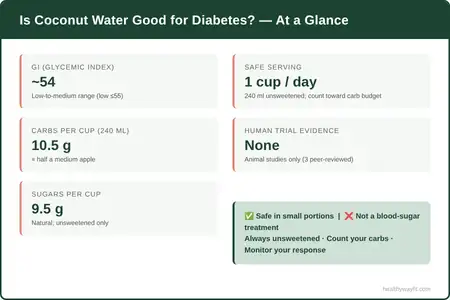
Coconut water is safe in small amounts for most people with diabetes, but it is not a free food. An unsweetened 240 ml (8 fl oz) serving contains 10.5 g of carbohydrates and 9.5 g of natural sugars — amounts that will raise blood glucose. Its glycemic index is approximately 54, sitting at the low-to-medium boundary of the GI scale, and its glycemic load per standard cup is around 5–6. Stick to one cup of unsweetened coconut water at a time, count it toward your daily carbohydrate budget, and avoid sweetened or flavoured versions.
What Is Coconut Water?
Coconut water is the clear liquid found inside young, green coconuts — not to be confused with coconut milk, which is extracted by pressing the white flesh. It forms naturally inside the nut and is harvested before the fruit fully matures. Fresh coconut water has a mildly sweet, slightly nutty taste and a thin consistency that is nothing like coconut milk.
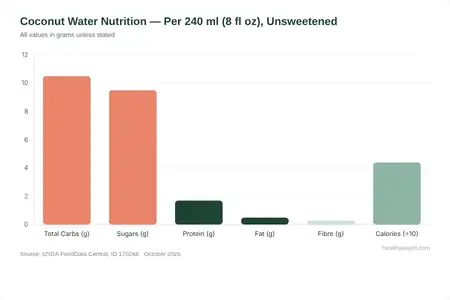
Nutritionally, it sits between plain water and fruit juice: more nutrients than water, but with carbohydrates that matter for blood glucose management. The table below shows what you get from one standard cup.
Nutrition per 240 ml (8 fl oz), unsweetened — USDA FoodData Central:
| Nutrient | Per 240 ml |
|---|---|
| Calories | 44 kcal |
| Total carbohydrates | 10.5 g |
| Sugars | 9.5 g |
| Dietary fibre | <1 g |
| Protein | 1.7 g |
| Fat | 0.5 g |
| Potassium | 396 mg (9% DV) |
| Manganese | 0.5 mg (24% DV) |
| Vitamin C | 24 mg (27% DV) |
The sugars in coconut water are naturally occurring — a mix of fructose, glucose and sucrose — not added. However, for blood glucose purposes, the source of sugar matters far less than the total amount. At 9.5 g of sugar and 10.5 g of total carbohydrate per cup, coconut water counts as a carbohydrate-containing food that requires monitoring and portion control.
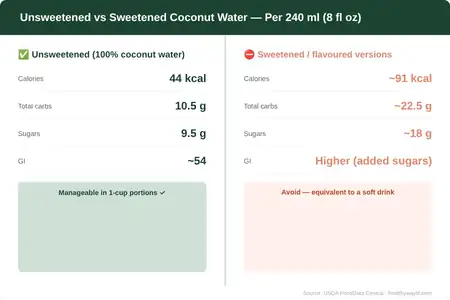
Sweetened packaged versions can reach 22.5 g of carbohydrates and 18 g of sugar per cup — more than doubling the glycaemic impact. More on that below.
Glycemic Index and Blood Sugar Impact
Coconut water has a glycemic index of approximately 54, which places it at the low-to-medium boundary of the GI scale (low ≤55, medium 56–69, high ≥70), according to the international GI tables published in Diabetes Care by Atkinson, Foster-Powell and Brand-Miller (2008). Its glycemic load per standard 240 ml serving is approximately 5–6, which falls in the low range (low <10, medium 10–19, high ≥20).
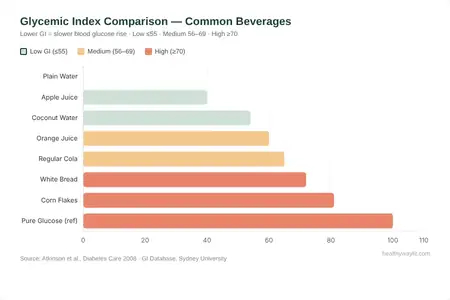
Glycemic index measures how quickly a food raises blood glucose compared with pure glucose (GI = 100). A GI of 54 means coconut water raises blood sugar more slowly than a regular soft drink (GI ~65) or white bread (GI ~70), but faster than water (GI = 0) and similarly to some whole fruits. Glycemic load is the more practical number for everyday use: it multiplies GI by the amount of carbohydrate in a serving, giving you a sense of the actual blood glucose impact of a realistic portion.
A glycemic load of 5–6 per cup is comparable to eating half a medium apple. That is manageable for most people with type 2 diabetes who are counting carbohydrates — provided the serving is measured and counted.
What raises the glycemic impact:
- Drinking more than one cup at a sitting
- Drinking on an empty stomach
- Using sweetened or concentrate-based versions
- Combining with other carbohydrate-containing foods without adjusting
What the Research Says About Coconut Water and Diabetes
Three peer-reviewed studies have examined coconut water and blood glucose, and all three found promising results. The important limitation: every study was conducted in animals — specifically in diabetic rats — and animal findings cannot be directly applied to people. Evidence tier: animal studies only; no human randomised controlled trials.
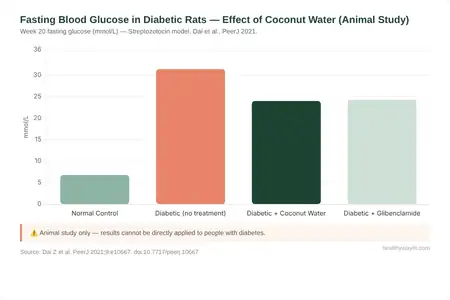
Dai et al., 2021 (PeerJ, DOI: 10.7717/peerj.10667)
Streptozotocin-induced diabetic rats given coconut water showed fasting blood glucose fall from approximately 31.4 mmol/L to 24.0 mmol/L over 20 weeks — a result statistically comparable to the diabetes drug glibenclamide (24.3 mmol/L). The coconut water group also showed reduced retinal thickening and lower vascular endothelial growth factor (VEGF) expression, both markers of diabetic eye complications. The researchers proposed that antioxidants in coconut water — ascorbic acid, cysteine, phenolic compounds and L-arginine — reduce oxidative stress, which is a key driver of insulin resistance and diabetic tissue damage.
Preetha et al., 2012 (Food & Function, PMID 22576019)
In alloxan-induced diabetic rats, coconut water supplementation improved fasting blood glucose and HbA1c, along with markers of oxidative stress. The researchers attributed the effect to coconut water’s potassium, magnesium, manganese, vitamin C and L-arginine content, which they proposed may enhance insulin sensitivity. Animal study; no human data reported.
Pinto et al., 2015 (Journal of Medicinal Food, PMID 25651375)
Coconut water demonstrated antiglycation (reduced formation of damaging advanced glycation end-products), hypoglycaemic and nephroprotective (kidney-protective) effects in alloxan-induced diabetic rats. Animal study; no human data reported.
What this means in practice: Research suggests that the antioxidant compounds in coconut water may support blood glucose regulation through oxidative-stress pathways. This mechanism is biologically plausible. However, no randomised controlled trial in people with diabetes has tested coconut water as a therapeutic intervention. Until human evidence emerges, coconut water should be treated as a food with useful micronutrients and a moderate carbohydrate load — not as a supplement that lowers blood glucose.
Note: Always consult a qualified healthcare professional before making changes to your diet, exercise routine or medication.
Coconut water is not a substitute for prescribed diabetes medication or management.
Unsweetened vs Sweetened: What Actually Matters
The gap between unsweetened and sweetened coconut water is larger than most people realise. Plain, unsweetened fresh or packaged coconut water contains the values in the nutrition table above. Many commercial products differ significantly:
Unsweetened (100% coconut water): ~44 calories, 10.5 g carbs, 9.5 g sugar per 240 ml
Sweetened or juice-blended: up to 91 calories, 22.5 g carbs, 18 g sugar per 240 ml
For people with diabetes, sweetened coconut water is closer to a soft drink than to a health food. Common signs a product is not plain coconut water:
- Ingredient list shows “sugar”, “cane sugar”, “fruit juice concentrate” or multiple fruits
- Flavours: mango, pineapple, passionfruit, lemon — most are sweetened or juice-blended
- Sugars per serving above 12 g per 240 ml indicates additions
- “From concentrate” can raise the glycaemic impact versus fresh
The only version worth considering for people with diabetes: plain, unsweetened, 100% coconut water — with a single ingredient on the label.
How Much Coconut Water Can You Drink With Diabetes?
One cup (240 ml / 8 fl oz) of unsweetened coconut water per day is a reasonable starting point for most adults with type 2 diabetes whose blood glucose is reasonably managed. Some clinicians suggest up to two cups (480 ml) after vigorous exercise when electrolyte replenishment is a priority.

The American Diabetes Association Standards of Medical Care in Diabetes (2024) recommends minimising sugar-sweetened beverages and monitoring total carbohydrate intake across all foods and drinks. One cup of coconut water counts as approximately 10–11 g of carbohydrates — roughly equivalent to one small piece of fruit — and should be factored into your daily carbohydrate budget.
Practical timing and pairing guidelines:
- Drink with a meal, not on its own. Pairing coconut water with protein or fibre slows gastric emptying and blunts the glycaemic rise.
- Post-exercise is the best window. After moderate activity, muscle cells are more insulin-sensitive, so the glucose from coconut water is taken up more efficiently.
- Avoid first thing in the morning on an empty stomach. Fasting blood glucose is more volatile at that time, and adding carbohydrates without food can cause an unpredictable spike.
- Measure your portion. Drink from a measured cup rather than straight from a carton, where it is easy to drink 500 ml or more without realising.
- Monitor your response. Check blood glucose 2 hours after drinking coconut water at least a few times when you first add it to your routine, to understand your individual response.
If you are taking insulin or a sulfonylurea, speak with your doctor before making coconut water a daily habit. Even a moderate carbohydrate load can affect dosing calculations.
For a fuller framework for managing carbohydrates with diabetes, see our guide to managing blood sugar with food.
Electrolytes and Other Benefits for People With Diabetes
Beyond carbohydrates, coconut water is one of the few naturally occurring beverages that provides meaningful amounts of potassium, manganese and vitamin C in a single serving.
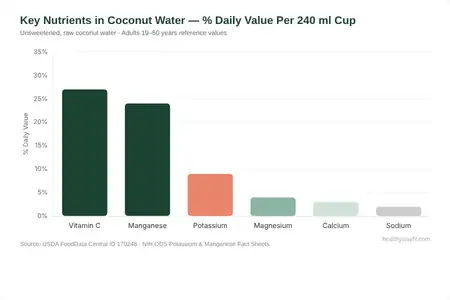
Potassium (396 mg per cup / 9% DV)
Potassium plays a role in insulin secretion and glucose uptake in muscle cells. The NIH Office of Dietary Supplements Potassium Fact Sheet for Health Professionals (2024) notes that higher potassium intake is associated with lower rates of type 2 diabetes in large population studies, though this is a correlational finding and does not establish causality. People with diabetic kidney disease may need to limit potassium — speak to your doctor first if you have any kidney complications.
Manganese (0.5 mg per cup / 24% DV)
Manganese is a cofactor for several enzymes involved in carbohydrate metabolism. The NIH Office of Dietary Supplements Manganese Fact Sheet (2021) notes that manganese-containing enzymes participate in gluconeogenesis, which is the liver’s process for producing glucose from non-carbohydrate sources. Whether dietary manganese intake meaningfully affects blood glucose in people with diabetes is not established.
Vitamin C (24 mg per cup / 27% DV)
Vitamin C is an antioxidant. A comprehensive review of coconut water’s chemical composition by Yong et al. (Molecules, 2009) noted that the high antioxidant content is a consistent finding across studies, with ascorbic acid as one of the primary contributors. In the context of diabetes, antioxidants may help reduce oxidative stress, which drives complications — though whether the amounts in coconut water are clinically significant for people has not been studied directly.
Electrolyte balance and hydration
High blood glucose draws water from cells, raising the risk of dehydration and electrolyte shifts. For people who exercise or live in warm climates, coconut water’s combination of potassium, sodium and natural carbohydrates makes it a more useful post-exercise drink than plain water — though it is not equivalent to clinical oral rehydration salts in cases of severe dehydration.
Coconut water is not a substitute for medical intervention in diabetic ketoacidosis or hyperosmolar hyperglycaemic state. In those situations, hospital-grade treatment is required.
For more on how foods interact with blood glucose, see our diabetes food list or the guide to fasting blood sugar vs HbA1c.
Tips for Drinking Coconut Water With Diabetes
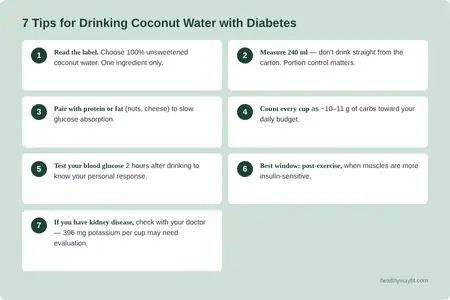
A few practical steps make coconut water a manageable addition rather than a glycaemic risk:
- Read every label. Choose 100% coconut water with a single ingredient. If the label lists sugar, juice or flavourings, put it back.
- Measure 240 ml exactly. Use a measuring cup the first few times until you can reliably estimate a cup.
- Pair with protein or fat. A handful of unsalted almonds or a piece of cheese alongside your coconut water slows glucose absorption meaningfully.
- Count it every time. 10–11 g of carbohydrate per cup is not trivial. Log it alongside your meal rather than treating it as a free fluid.
- Check your blood glucose response. Test at 2 hours after your first few servings to understand how your body responds.
- Do not use it to treat hypoglycaemia (low blood sugar). Coconut water is too slow to raise blood glucose quickly enough in a hypo. Use glucose tablets or juice concentrate as directed by your care team.
- Be cautious with kidney disease. If your creatinine or potassium levels are elevated, coconut water’s 396 mg of potassium per cup may be too much. Ask your doctor.
When to See a Doctor
Coconut water is a food, and most people with stable, well-managed type 2 diabetes can include it occasionally without issue. Contact your doctor or a registered dietitian if:
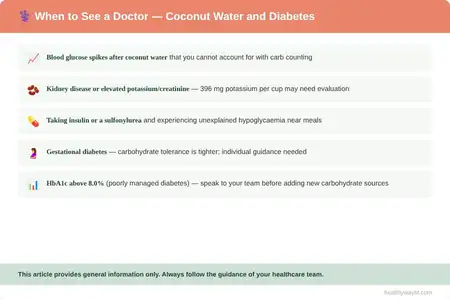
- You consistently see blood glucose readings above your target 2 hours after drinking coconut water, even with careful portion control
- You are on a very low-carbohydrate plan prescribed for blood glucose management and are unsure whether any fruit-based drink fits
- You have been diagnosed with diabetic nephropathy or chronic kidney disease, or your lab results show elevated creatinine, potassium or uric acid — coconut water’s potassium content may need to be evaluated in your context
- Your HbA1c is above 8.0% and your diabetes is not yet well managed — this is not the time to experiment with new carbohydrate sources without guidance
- You are pregnant with gestational diabetes — carbohydrate tolerance is tighter and beverage choices need individual, trimester-specific guidance
- You use insulin or a sulfonylurea and experience unexplained hypoglycaemia at times when you have been drinking coconut water with meals
Always verify blood glucose thresholds, medication adjustments and dietary restrictions with your healthcare team. The numbers mentioned in this article are general references — individual targets differ.
Frequently Asked Questions
Can coconut water replace water for people with diabetes?
No. Plain water has zero carbohydrates and zero glycaemic impact. Coconut water contains approximately 10.5 g of carbohydrates per cup and must be counted as part of your carbohydrate allowance. Replacing water with coconut water without adjusting for the extra carbohydrate would raise blood glucose over time. Plain water remains the best daily hydration choice for people with diabetes.
Does coconut water lower blood sugar?
Current evidence comes from animal studies only, which cannot be directly applied to people. Three peer-reviewed studies found blood-glucose-lowering effects in diabetic rats, but no human randomised controlled trial has confirmed a therapeutic effect. Do not use coconut water as a substitute for prescribed medication or as an intentional blood-glucose-lowering strategy.
Is coconut water better than fruit juice for diabetes?
Coconut water compares moderately well. Most fruit juices — orange (GI ~50–75), apple (GI ~40–60), mango (GI ~55–60) — contain similar or greater amounts of sugar and lack the electrolytes in coconut water. However, whole fruit with its natural fibre intact is preferable to either juice or coconut water for blood glucose management, because fibre slows glucose absorption. See our guide on is mango good for diabetes for a direct comparison of one common fruit.
Is coconut water safe for type 1 diabetes?
People with type 1 diabetes can drink unsweetened coconut water, but because insulin dosing requires precise carbohydrate counting, the carbohydrates in coconut water must be factored into bolus calculations. Discuss with your endocrinologist or diabetes educator how best to incorporate it, especially around exercise.
Can I drink coconut water while fasting?
Coconut water contains carbohydrates and will break a carbohydrate fast by stimulating insulin release and raising blood glucose. Whether it breaks a specific religious or intermittent fast depends on the protocol — consult your doctor or the guidelines for your fasting programme.
What is the best brand of coconut water for diabetes?
Any brand whose ingredient list reads only “coconut water” (or “young coconut water”) with no added sugar, juice or flavourings. Check the nutrition panel: sugars at or below 10 g per 240 ml serving indicates a plain, unsweetened product. Fresh coconut water from a young green coconut remains the least processed option.
The Bottom Line
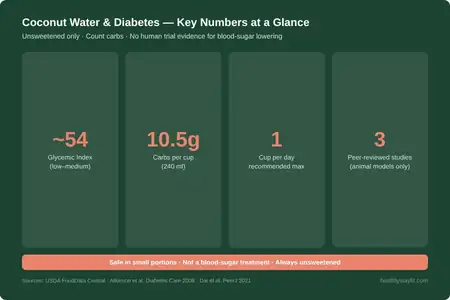
Coconut water is not a superfood cure for diabetes, but it is not off-limits either. Unsweetened coconut water — one cup (240 ml) at a time, counted toward your daily carbohydrate budget — fits within a diabetes-friendly eating pattern for most people.
Three peer-reviewed animal studies found that coconut water may reduce fasting blood glucose and support antioxidant pathways in diabetic rodents. No human clinical trial has replicated this. Until that evidence exists, the responsible view is: enjoy coconut water for what it reliably delivers — natural electrolytes, manganese and vitamin C, with a modest caloric load — not for a blood-glucose-lowering effect that has not been proven in people.
One rule that always applies: choose unsweetened, read the label, and count every cup.
Reviewed: October 2026. The evidence and guidelines referenced in this article will be updated as new research becomes available.
References
- USDA Agricultural Research Service. FoodData Central: Coconut water, raw. FoodData Central ID 170248. https://fdc.nal.usda.gov/food-details/170248/nutrients. Accessed October 2026.
- Atkinson FS, Foster-Powell K, Brand-Miller JC. International tables of glycemic index and glycemic load values: 2008. Diabetes Care. 2008;31(12):2281–2283. doi:10.2337/dc08-1239
- Dai Z, Wang X, Peng Y, et al. Coconut water attenuated diabetic retinopathy and nephropathy in streptozotocin-induced diabetic rats. PeerJ. 2021;9:e10667. doi:10.7717/peerj.10667
- Preetha PP, Girija Devi V, Rajamohan T. Hypoglycemic and antioxidant potential of coconut water in experimental diabetes. Food & Function. 2012;3(7):753–757. doi:10.1039/c2fo10295b
- Pinto CO, Batista PS, Ferreira AC, et al. Antiglycation, hypoglycemic, and nephroprotective activities of coconut water in alloxan-induced diabetic rats. Journal of Medicinal Food. 2015;18(9):1033–1040. doi:10.1089/jmf.2014.0118
- American Diabetes Association. Standards of Medical Care in Diabetes—2024. Diabetes Care. 2024;47(Suppl 1):S1–S321. doi:10.2337/dc24-SINT
- National Institutes of Health Office of Dietary Supplements. Potassium: Fact Sheet for Health Professionals. Updated June 2022. https://ods.od.nih.gov/factsheets/Potassium-HealthProfessional/
- National Institutes of Health Office of Dietary Supplements. Manganese: Fact Sheet for Health Professionals. Updated March 2021. https://ods.od.nih.gov/factsheets/Manganese-HealthProfessional/
- Yong JWH, Ge L, Ng YF, Tan SN. The chemical composition and biological properties of coconut (Cocos nucifera L.) water. Molecules. 2009;14(12):5144–5164. doi:10.3390/molecules14125144