
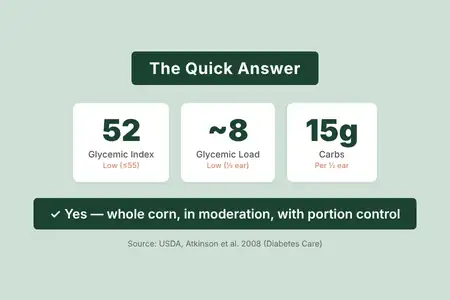
Corn can fit into a diabetes-friendly diet — but the type, portion size, and preparation matter enormously. A medium ear of boiled sweet corn has a glycemic index (GI) of 52 (low) and a glycemic load (GL) of roughly 8–15 depending on portion, placing it in similar territory to sweet potato or a small serving of brown rice. The catch is that cornflakes, corn chips, and corn syrup behave very differently, with GI values climbing to 74–81 and minimal fiber to slow glucose absorption.
Medical disclaimer: This article is for informational purposes only and does not constitute medical advice. Always consult a qualified healthcare professional before making changes to your diet, exercise routine, or medication.
What Is Corn? Nutrition at a Glance
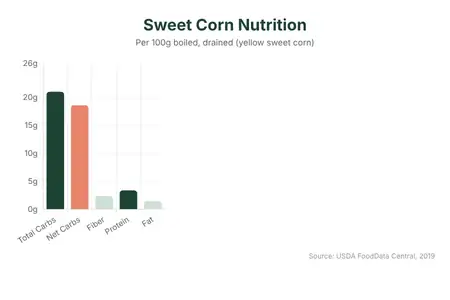
Sweet corn (Zea mays) is a starchy vegetable — botanically a grain — that provides a mix of carbohydrates, dietary fiber, and micronutrients. According to the USDA FoodData Central, one cup of boiled, drained yellow sweet corn (154g) contains:
| Nutrient | Per 100g (boiled) | Per 1 cup / 154g |
|---|---|---|
| Calories | 96 kcal | 148 kcal |
| Total carbohydrates | 21.0g | 32.3g |
| Dietary fiber | 2.4g | 3.7g |
| Sugars | 4.5g | 6.9g |
| Protein | 3.4g | 5.2g |
| Fat | 1.5g | 2.3g |
The net digestible carbohydrate (total carbs minus fiber) per 100g is approximately 18.6g — meaningful for carb-counting purposes.
Corn also provides B vitamins including thiamine, niacin, and folate, plus vitamin C, magnesium, and potassium. These micronutrients support general metabolic health, though corn is not a primary or concentrated source of any of them.
The critical distinction for diabetes management: corn is a starchy vegetable, not a non-starchy one. It behaves nutritionally more like brown rice or a small potato than like broccoli or spinach. That means it contributes meaningfully to your daily carbohydrate intake and needs to be counted, not treated as a free food.
The Glycemic Index and Blood Sugar Impact of Corn
The glycemic index (GI) measures how quickly a food raises blood glucose compared to pure glucose (GI = 100). A GI below 55 is classified as low, 56–69 is medium, and 70 or above is high.
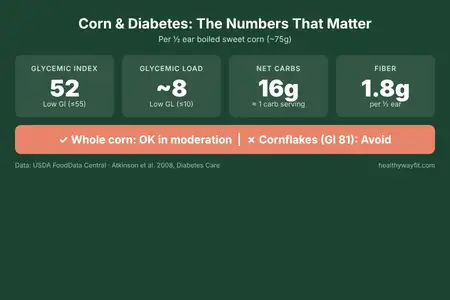
According to the International Tables of Glycemic Index and Glycemic Load Values (Atkinson et al., 2008, Diabetes Care), boiled sweet corn has a GI of approximately 52 — placing it in the low-GI category alongside foods like oatmeal (GI 55) and sweet potato (GI 54).
GI alone tells only part of the story. Glycemic load (GL) accounts for portion size, giving a more practical picture of how a realistic serving affects blood sugar:
GL = (GI × grams of available carbohydrate per serving) ÷ 100
- Half ear of corn (~75g edible, ~16g digestible carbs): GL ≈ 8 (low)
- One full ear of corn (~100g edible, ~19g digestible carbs): GL ≈ 10–15 (medium)
A low GL (≤10) produces a modest blood glucose rise; a medium GL (11–19) produces a moderate one. Half an ear of corn at a meal sits on the low-to-medium GL boundary — a very different picture from cornflakes (GL ~20 per cup) or corn chips.

Different Forms of Corn: Which Are Best for Diabetes?
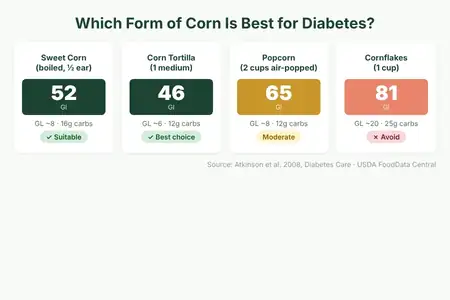
Not all corn is equal. Whole corn kernels retain their fiber matrix, which slows starch digestion and moderates glucose release. Processing strips away that protection, driving GI values sharply higher.
| Form | GI | Typical serving | Carbs per serving | GL | Verdict |
|---|---|---|---|---|---|
| Sweet corn, boiled (½ ear) | 52 | ~75g | ~16g | ~8 | ✓ Suitable in moderation |
| Corn tortilla (1 medium, 26g) | 46 | 26g | ~12g | ~6 | ✓ Good choice |
| Air-popped popcorn (2 cups) | 65 | ~16g | ~12g | ~8 | Moderate — watch portions |
| Cornflakes (1 cup / 30g) | 81 | 30g | ~25g | ~20 | ✗ High GI and GL — avoid |
| Corn chips / nachos (28g) | 74+ | 28g | ~18g | ~13 | ✗ Limit or avoid |
| High-fructose corn syrup | N/A | — | — | Very high | ✗ Avoid |
Corn tortillas stand out as one of the better corn-based options — lower GI than most bread, and the smaller size keeps the GL comfortably low. Cornflakes represent the worst-case corn scenario: heavy processing eliminates virtually all fiber, producing a GI higher than white bread and a GL above 20 per standard bowl.
For more on how different foods compare in managing blood sugar, see our guide to the best foods for blood sugar control.
What the Research Says
Three evidence streams are particularly relevant to corn and diabetes.
Soluble corn fiber and glycemic response. A study published in the FASEB Journal (Dahl et al., 2020; PMC7231297) found that soluble corn fiber dose-dependently reduced postprandial (after-meal) glucose and insulin responses in overweight and obese adults. Participants who consumed higher doses of soluble corn fiber showed significantly lower blood sugar peaks compared to the control group. This supports the idea that fiber-intact corn products have a meaningfully different metabolic effect than fiber-stripped, processed corn products.
Resistant starch. Whole corn kernels contain resistant starch — a type of carbohydrate that functions more like dietary fiber than like digestible starch. A review by Higgins (2014) in Critical Reviews in Food Science and Nutrition found that diets higher in resistant starch are associated with improved insulin sensitivity and reduced postprandial glucose responses. Processing corn into flakes, tortilla chips, or puffed snacks substantially reduces resistant starch content.
ADA dietary guidance. The American Diabetes Association’s Standards of Medical Care in Diabetes — 2024 do not classify any food as categorically forbidden. Instead, they emphasize total carbohydrate management, food quality over quantity alone, and individual monitoring. The ADA supports choosing nutrient-dense carbohydrates — those with lower GI and higher fiber content — over refined carbohydrates and added sugars. Whole corn fits that description; cornflakes and corn syrup do not.
The GI concept itself was first formalized by Jenkins et al. (1981) in the American Journal of Clinical Nutrition, and the classification system has since been validated across hundreds of foods in controlled studies. The low-GI classification for sweet corn has been replicated consistently.

How Much Corn Can You Eat With Diabetes?
There is no universal carbohydrate target that applies to every person with diabetes. The ADA recommends individualized goals set with a registered dietitian, based on medications, blood glucose targets, activity level, and overall diet pattern.
A practical starting point for meal planning:
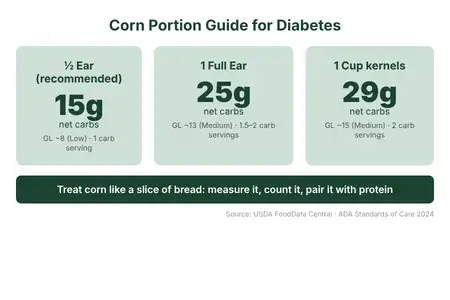
- Half an ear of boiled sweet corn (~75g, ~15–16g carbs) = one carbohydrate serving (approximately 15g)
- One full ear (~100g, ~20–25g carbs) = roughly 1.5–2 carbohydrate servings
- One cup of corn kernels (~154g, ~32g carbs) = approximately 2 carbohydrate servings
If your meal plan targets 45–60g of carbohydrates per meal (a commonly referenced range in diabetes nutrition guidelines), half an ear of corn uses about one-third of that budget, leaving room for other carbohydrate sources like legumes, fruit, or a small portion of whole grains.
The most practical rule of thumb: treat corn the same as you’d treat a slice of whole-grain bread or half a cup of cooked brown rice — it’s a starchy carb to measure and include in your total, not to add on top of other starches at the same meal.
According to the National Institute of Diabetes and Digestive and Kidney Diseases (NIDDK), checking blood glucose 1–2 hours after meals is the most direct way to understand how specific foods affect your individual response. Because glycemic responses vary between people, personal monitoring provides data no population study can replicate.
Tips for Eating Corn With Diabetes
Choosing the right type and preparation makes a significant difference to how corn affects blood sugar. These tips are consistent with guidance from the CDC on carbohydrate management in diabetes and the Mayo Clinic’s diabetes diet recommendations.
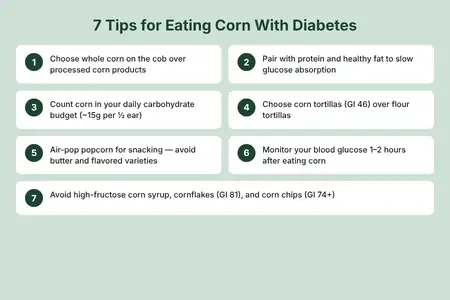
- Stick to whole corn over processed forms. Corn on the cob and frozen corn kernels retain their fiber and resistant starch. Cornflakes, corn chips, and corn syrup do not — and their GI and GL values show it.
- Pair corn with protein and healthy fat. Combining starchy carbohydrates with protein (chicken, eggs, legumes, Greek yogurt) and unsaturated fat (olive oil, avocado, nuts) slows stomach emptying and reduces the speed of glucose absorption.
- Count corn in your meal carbohydrate budget. Corn is not a free food. Half an ear provides roughly 15g of carbohydrate — the same as a small bread roll or a medium apple.
- Choose corn tortillas over flour tortillas. Corn tortillas (GI ~46, ~12g carbs per piece) are a better choice than flour tortillas (GI ~50–70, 15–25g carbs depending on size). Check labels for hydrogenated oils or added sugars in commercial varieties.
- Air-pop popcorn if you want a corn-based snack. Three cups of plain air-popped popcorn provides about 18g of carbohydrates and 3g of fiber — a manageable snack. Buttered, caramel, and flavored varieties add significant fat, sugar, and sodium.
- Monitor your blood glucose response. Individual glycemic responses to the same food can vary substantially. Checking blood sugar 1–2 hours after eating corn gives you data specific to your body and eating pattern.
- Avoid corn-based sweeteners and ultra-processed corn products. High-fructose corn syrup (HFCS), corn syrup, and corn-derived sweeteners in sodas, sauces, and packaged foods are associated with impaired insulin signaling and should be limited regardless of overall carbohydrate intake.
When to See a Doctor
Corn is generally safe to eat in moderate portions for most people with diabetes. Certain situations, however, warrant professional guidance.
Consult your doctor or diabetes care team if:
- Your blood glucose rises more than 2–3 mmol/L (36–54 mg/dL) above your pre-meal level after eating corn consistently
- You’re adjusting insulin doses or medications and need help incorporating starchy vegetables into your meal plan accurately
- You’ve been newly diagnosed with type 2 diabetes and have not yet received individualized dietary counseling
- You’re experiencing unexplained weight gain or persistent difficulty controlling blood glucose despite dietary changes
- You’re pregnant or have gestational diabetes, where carbohydrate management thresholds and monitoring targets differ from standard type 2 guidelines
A referral to a registered dietitian (RD) or certified diabetes care and education specialist (CDCES) is particularly valuable for building a personalized meal plan that includes foods like corn in amounts matched to your specific medications, glucose targets, and lifestyle.

Frequently Asked Questions
Can I eat corn if I have type 2 diabetes? Yes, in moderate portions. Half an ear of boiled sweet corn (~15g carbs) is a reasonable carbohydrate choice at a meal, especially when paired with protein and non-starchy vegetables. The key is counting it in your total daily carbohydrate intake and monitoring your individual blood glucose response.
Does corn raise blood sugar? Whole sweet corn causes a moderate blood sugar rise (GI 52, low-to-medium GL). Processed corn products such as cornflakes (GI 81) raise blood sugar significantly faster. The form of corn matters as much as the amount.
How many carbs are in one ear of corn? A medium ear of boiled sweet corn contains approximately 27–31g of total carbohydrates and 3–3.5g of dietary fiber, giving a net digestible carbohydrate count of roughly 24–27g. Weigh or measure for accuracy, as ear sizes vary.
Is popcorn OK for people with diabetes? Air-popped popcorn (GI ~65, medium) can be eaten in small portions — typically 2–3 cups — as a snack providing about 12–18g of carbohydrates. Avoid buttered, caramel, and heavily flavored varieties.
Is corn better or worse than rice for blood sugar? Boiled sweet corn (GI 52) has a lower glycemic index than white rice (GI 64–72) and is comparable to brown rice (GI 50–55). Neither is a poor choice when portions are appropriate. Corn provides slightly more fiber per gram than white rice, which is a modest advantage.
Can corn help with insulin resistance? Whole corn’s fiber and resistant starch content may support insulin sensitivity, according to research on both soluble corn fiber and dietary resistant starch. This is different from saying corn “treats” insulin resistance — it is one dietary factor among many. For a fuller picture, see our article on the insulin resistance diet.
The Bottom Line
Corn is not off-limits for people with diabetes. Whole sweet corn has a low GI of 52 and provides fiber that helps moderate its blood glucose impact. The key rules: keep portions to about half an ear (15–16g carbs) per meal, choose whole or minimally processed forms, pair corn with fat and protein, and always count its carbohydrates within your daily target.
The forms to avoid are processed corn products: cornflakes, corn chips, and corn syrup behave very differently from whole corn — high GI values, minimal fiber, and a rapid blood sugar spike that makes them poor choices for diabetes management.
If you’re comparing how different fruits and vegetables affect blood sugar, you may also find it useful to read our articles on is mango good for diabetes and sweet potato and diabetes.
References
- U.S. Department of Agriculture. FoodData Central: Sweet corn, yellow, cooked, boiled, drained, without salt. 2019. https://fdc.nal.usda.gov/fdc-app.html#/food-details/170108/nutrients
- Atkinson FS, Foster-Powell K, Brand-Miller JC. International tables of glycemic index and glycemic load values: 2008. Diabetes Care. 2008;31(12):2281–2283. https://doi.org/10.2337/dc08-1239
- Dahl WJ, Ziegler AM, Fulgoni VL, Higgins KA. Soluble corn fiber dose-dependently reduced postprandial glucose and insulin responses in overweight and obese adults. FASEB Journal. 2020. https://www.ncbi.nlm.nih.gov/pmc/articles/PMC7231297/
- Higgins JA. Resistant starch and energy balance: impact on weight loss and maintenance. Critical Reviews in Food Science and Nutrition. 2014;54(9):1158–1166. https://doi.org/10.1080/10408398.2011.629352
- American Diabetes Association. Standards of Medical Care in Diabetes — 2024. Diabetes Care. 2024;47(Suppl 1). https://doi.org/10.2337/dc24-Sint
- Jenkins DJA, Wolever TMS, Taylor RH, et al. Glycemic index of foods: a physiological basis for carbohydrate exchange. American Journal of Clinical Nutrition. 1981;34(3):362–366. https://doi.org/10.1093/ajcn/34.3.362
- National Institute of Diabetes and Digestive and Kidney Diseases. Diabetes diet, eating, and physical activity. NIH. https://www.niddk.nih.gov/health-information/diabetes/overview/diet-eating-physical-activity
- Centers for Disease Control and Prevention. Understanding carbs. CDC. https://www.cdc.gov/diabetes/healthy-eating/understanding-carbs.html
- Mayo Clinic. Diabetes diet: Create your healthy-eating plan. https://www.mayoclinic.org/diseases-conditions/diabetes/in-depth/diabetes-diet/art-20044295
By Kirti, Founder & Serial Entrepreneur, HealthyWayFit