

No, diabetes cannot be transmitted sexually. It is not an infection, so it cannot pass between partners through sex, kissing, saliva or semen. Couples can share the risk of type 2 diabetes, probably because they share meals, routines and weight trends and often have similar backgrounds. Partners can also pass on infections such as hepatitis or, less often, thrush, and diabetes can change sex for both of them.
By Kirti, founder and serial entrepreneur, HealthyWayFit. Last updated October 2026.
Can diabetes be transmitted sexually?
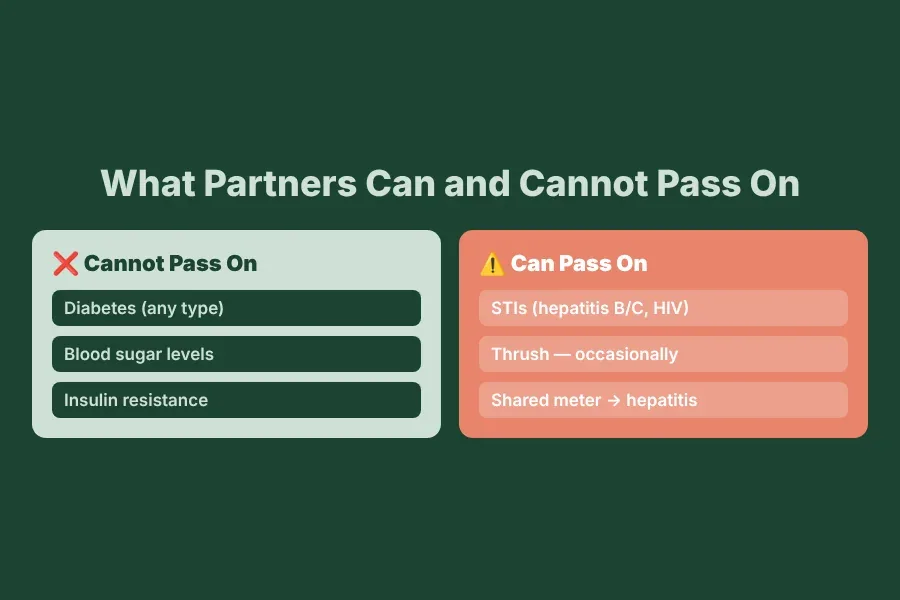
Diabetes is not contagious; no type of it spreads from person to person. Sex, kissing, sharing a bed, food or a toilet cannot give anyone diabetes.
The World Health Organization defines diabetes as a chronic disease in which the pancreas does not produce enough insulin or the body cannot use the insulin it makes. That is a problem inside one person’s metabolism, not something carried in body fluids.
| Between partners | Can it pass on? | Why |
|---|---|---|
| Diabetes itself (type 1, type 2 or gestational) | No | It is not an infectious disease |
| Type 2 diabetes risk | Linked, not transmitted | Couples often share food, activity and weight trends |
| Sexually transmitted infections (STIs) | Yes, with or without diabetes | Diabetes does not raise STI risk, according to the American Diabetes Association |
| Thrush (yeast infection) | Occasionally, during sex | Not an STI; more likely when blood sugar runs high |
| Hepatitis B and C via shared glucose meters or lancets | Yes | Blood-borne viruses, not diabetes |
Why you can’t catch diabetes
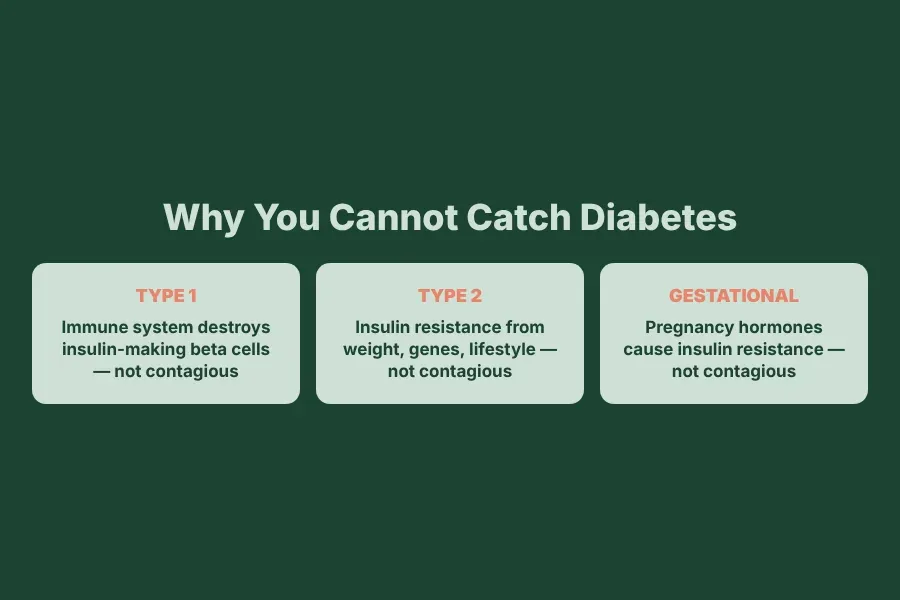
Each type starts inside the body, from the immune system, insulin resistance or pregnancy hormones.
- Type 1 diabetes develops when the immune system destroys the insulin-making beta cells in the pancreas. The NIDDK says genes and environmental factors may trigger that attack; the WHO notes that its full cause is still unknown.
- Type 2 diabetes, the most common type, develops when the pancreas does not make enough insulin and the body’s cells resist it. Overweight or a large waist, being 35 or older, family history, prediabetes, physical inactivity, smoking, a history of gestational diabetes and Asian ancestry (the NIDDK names Asian Americans) all raise the risk, per the US NIDDK (India screens adults from 30; see below).
- Gestational diabetes appears during pregnancy, when pregnancy hormones are thought to cause insulin resistance and the pancreas cannot keep up.
The American Diabetes Association lists viruses as a possible trigger for type 1 diabetes in some people. Even if that link is confirmed, a person would be catching a common virus, not diabetes; most people who get such viruses never develop diabetes.
Can a wife get diabetes from her husband?
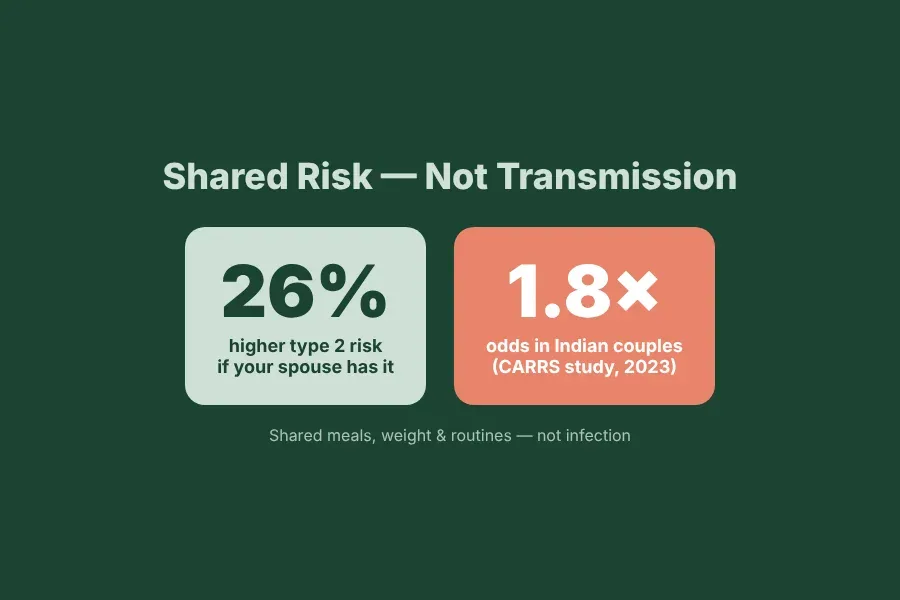
A wife cannot catch diabetes from her husband, or a husband from his wife. Research does show that the spouse of someone with type 2 diabetes is more likely to have it too, probably because couples share kitchens, schedules and often weight, income and education levels; the Indian study below linked shared overweight and higher income and education to both partners having a chronic condition such as diabetes. That makes a partner’s diagnosis a good reason to get tested yourself.
A 2014 meta-analysis in BMC Medicine reviewed six studies covering 75,498 couples, pooled five, and found that having a spouse with diabetes was associated with a 26% higher risk of diabetes. When the researchers also adjusted for body mass index (BMI), the estimate fell to 18% and was no longer statistically significant, which suggests shared body weight may explain part of the link. In the two studies that tested blood glucose rather than relying on self-report, the link with diabetes or prediabetes was stronger, at about double the odds.
Indian data point the same way. A 2023 study of 2,548 couples in urban India and Pakistan (the CARRS cohort) found both partners had diabetes in 11.5% of couples. A wife whose husband had diabetes had about 1.8 times the odds of having it herself, and the same held the other way round. The authors suggest prevention and management of chronic conditions, diabetes included, could focus on couples.
These are associations, not proof that one partner’s diabetes causes the other’s. They describe risk you can lower, not an infection you can catch. India has an estimated 101 million people living with diabetes and 136 million with prediabetes (ICMR-INDIAB, 2021 figures), so in many couples at least one partner is affected.
Is it safe to kiss or marry someone with diabetes?
Kissing, hugging, sharing food and having sex with a person who has diabetes cannot give you diabetes, because there is nothing infectious about it (STI precautions still apply, as with any partner). The practical questions are about managing the condition together and planning pregnancy.
Discuss two things before marriage or pregnancy:
- Pregnancy planning. High blood sugar can harm a baby in the first weeks of pregnancy, before many women know they are pregnant, according to the NIDDK. A woman with diabetes should plan pregnancy with her doctor and get her blood sugar into range first.
- Children’s risk. Diabetes is not transmitted to children like an infection, but the tendency can be inherited. The ADA puts a child’s risk of type 1 diabetes at 1 in 17 if the father has type 1, and 1 in 25 if the mother has it and the child is born before she turns 25, or 1 in 100 if born after. Type 2 diabetes runs more strongly in families, through both genes and shared habits, and the ADA notes that studies show it is possible to delay or prevent it by exercising and losing weight.
Does diabetes raise your risk of STIs?
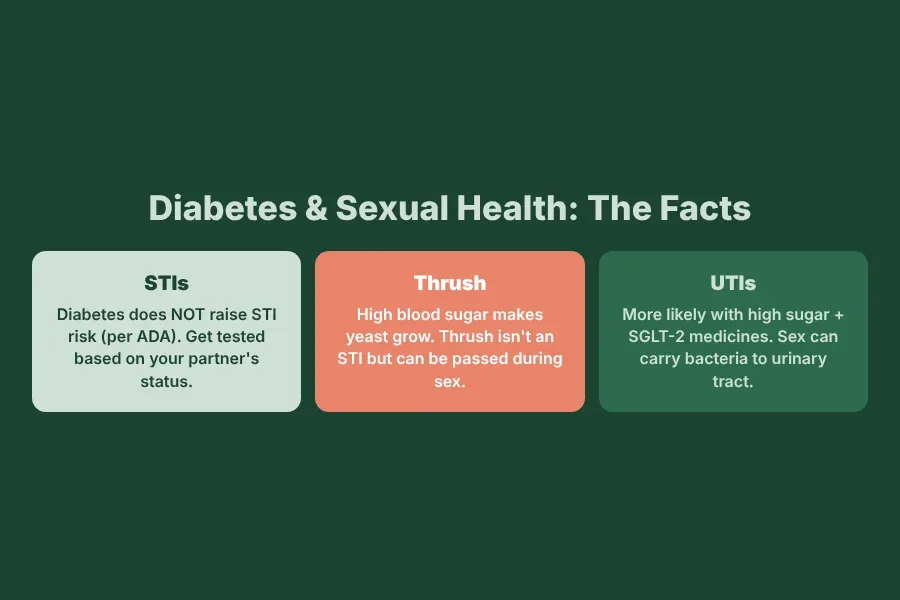
The American Diabetes Association states that people with diabetes are at no greater risk of sexually transmitted diseases than people without it. The UK patient-education site Know Diabetes also says there is no link between diabetes and STIs. You get an STI from a partner who has one, with or without diabetes; condoms lower that risk.
Google’s AI Mode said otherwise. When we searched “can diabetes be transmitted sexually” in Google AI Mode on 5 October 2026 (India, English), the answer said high blood sugar makes people more susceptible to infections and listed STIs among them, citing a UK patient page from MyWay Diabetes that gives no source for the claim. High blood sugar does make some infections more likely, but the ones the NIDDK and Know Diabetes name are thrush and UTIs, not STIs:
- Yeast infections (thrush). High blood sugar makes vaginal yeast infections more likely, per the NIDDK. Men get thrush too, as irritation, burning and redness around the head of the penis. The NHS says thrush is not an STI but can be triggered by sex or, less often, passed on during it, and that partners only need treatment if they have symptoms. Thrush is a common side effect of dapagliflozin, an SGLT-2 inhibitor that lowers blood sugar by passing more of it out in urine; if you take it or a similar medicine and get repeated thrush, tell your doctor rather than stopping it yourself.
- Urinary tract infections (UTIs). UTIs are also more likely when sugars run high, and sex can carry bacteria into the urinary tract, per Know Diabetes, which adds that SGLT-2 medicines can sometimes raise the risk too.
The link also runs the other way. The same MyWay page notes that an STI can push blood sugar up sharply in someone with diabetes, and the NHS lists being unwell among the causes of diabetic ketoacidosis (DKA). People with diabetes who notice burning, itching or unusual discharge should see a doctor promptly rather than wait it out.
The indirect links: infections and shared equipment
A few sexually or blood-borne infections are linked to a higher chance of developing type 2 diabetes. In these cases the partner passes on an infection, which may raise diabetes risk; diabetes itself still does not pass between people.
- Hepatitis C. A 2008 meta-analysis in the Journal of Hepatology found people with hepatitis C had roughly 1.7 times the risk of type 2 diabetes compared with uninfected people. The CDC says hepatitis C can spread during sex, though this is uncommon.
- HIV. Type 2 diabetes is more likely in people with HIV, according to NIH HIVinfo. Listed reasons include some HIV medicines (including older drugs such as ritonavir), lipodystrophy, HIV-related inflammation and hepatitis C co-infection.
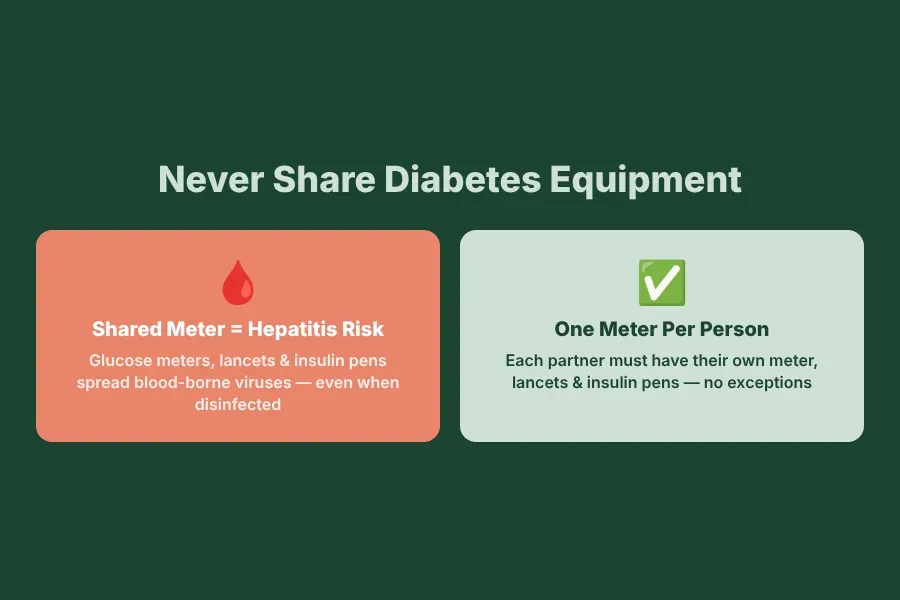
- Shared glucose meters, lancets and insulin pens. Sharing these spreads blood-borne viruses, not diabetes. In 2024 a US nursing-home resident acquired hepatitis B in a case the CDC linked to a shared glucometer, even though the meters were being disinfected between uses. Couples where both partners check their sugar should each use their own meter, lancets and pens.
How diabetes affects sex for both partners
Over time, high blood sugar can damage the nerves and blood vessels that supply the genitals, and some diabetes medicines can cause low blood sugar during sex. Most of these problems can be treated, and better glucose control helps prevent many of them.
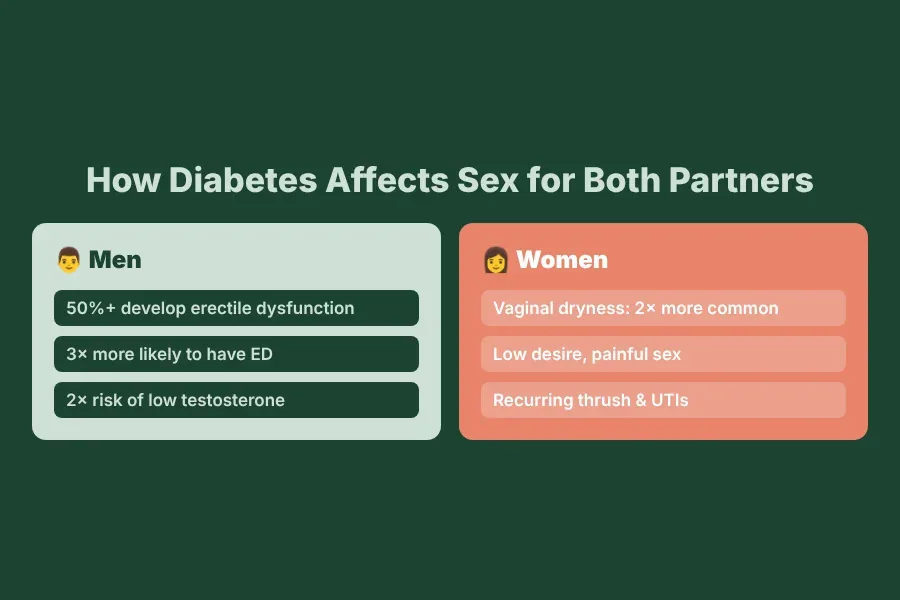
For men. More than half of men with diabetes develop erectile dysfunction (ED). They are over three times as likely to have it as men without diabetes and may develop it 10 to 15 years earlier, per the NIDDK. The ADA adds that men with diabetes, especially those with type 2 or overweight, have about twice the risk of low testosterone, which can lower desire. Many men with ED only later learn they have diabetes, the ADA notes.
For women. Nerve damage and reduced blood flow can cause low desire, vaginal dryness and painful sex; the ADA reports vaginal dryness is twice as common in women with diabetes. A lubricant can help with dryness, and recurrent thrush or UTIs are worth raising with a doctor.
Low blood sugar during sex. Sex is physical activity. The MyWay page also notes that if you take insulin or a drug such as gliclazide, sex can bring on a hypo, and alcohol raises that risk; it suggests checking glucose before and after sex and keeping something sugary nearby.
Ask a doctor before taking ED tablets. If you use a nitrate heart medicine such as glyceryl trinitrate (GTN) for chest pain, do not take sildenafil or similar tablets without your doctor’s advice; the NHS says they are not usually prescribed together.
What to do if your partner has diabetes
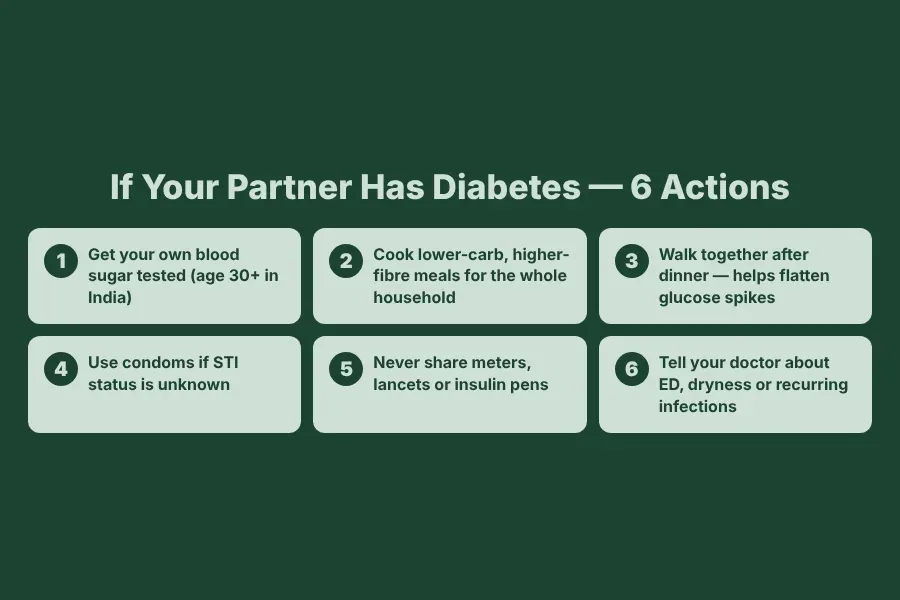
Share the work of preventing or managing diabetes:
- Get your own blood sugar tested. A partner’s type 2 diagnosis is a reason to check your fasting glucose or HbA1c, especially if you are 30 or older (the age from which India’s national NCD screening campaign checks adults), carry extra weight around your waist or have a family history.
- Change the shared plate. Cooking one lower-refined-carb, higher-fibre menu for the whole household helps both of you; see our guide to a diabetes-friendly Indian thali and diabetes-friendly dal, roti and rice.
- Move together. A short walk after dinner is easy to do as a couple; here is why walking after meals helps flatten glucose spikes.
- Practise safer sex. Use condoms with any partner whose STI status you don’t know, whether or not either of you has diabetes.
- Keep diabetes kits personal. Never share glucose meters, lancets, insulin pens or needles.
- Bring up sexual problems with the doctor. ED, dryness, low desire and recurring infections are treatable, and they can signal that blood sugar needs attention.
Can you live a normal life with type 2 diabetes? Managing blood glucose, blood pressure and cholesterol and not smoking helps prevent complications such as heart disease, stroke and eye disease, per the NIDDK. Some people bring type 2 into remission with sustained lifestyle change; read our honest look at whether type 2 diabetes can be reversed.
The takeaway for couples
Diabetes is not sexually transmitted and cannot be caught from a partner; what a partner can pass on is an infection, and a few, such as hepatitis C and HIV, may raise diabetes risk. What couples share is risk: a partner of someone with type 2 diabetes is more likely to have it too, probably because couples share weight patterns, meals and routines. The ADA says diabetes does not raise the risk of catching an STI, but high blood sugar makes thrush and UTIs more likely, and long-term high sugar can affect erections, lubrication and desire. Get tested if your partner is diagnosed, keep meters and lancets personal, use condoms when STI status is unknown, and treat diabetes as a household project.
If you would like a structured, doctor-supervised plan built around your life and food preferences, book a free consultation with the HealthyWayFit team.
Disclaimer: This article is for educational purposes only and is not medical advice. It is not a substitute for diagnosis or treatment by a qualified healthcare professional. Do not start, stop or change any medication without your doctor’s supervision.



