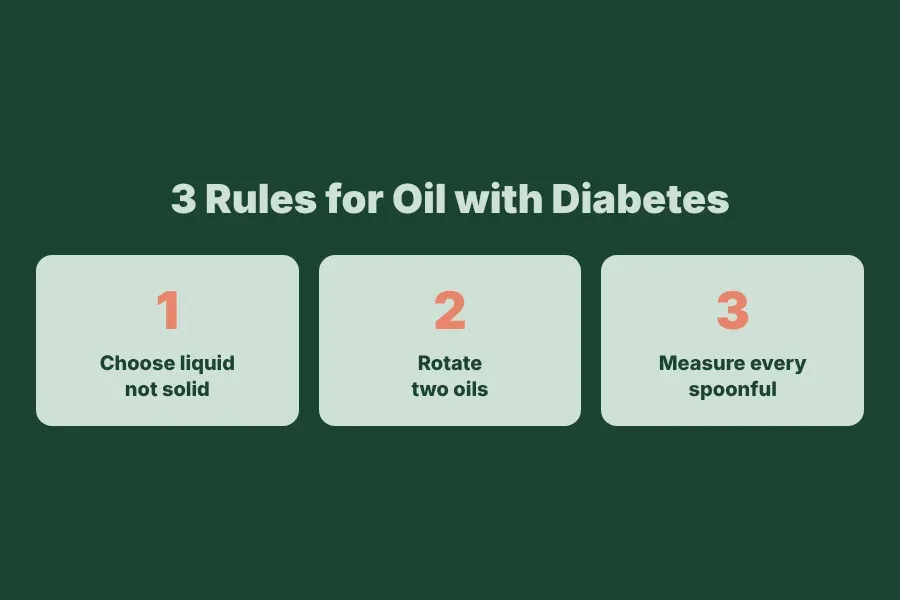

The best cooking oil for heart and diabetes is not a single bottle. It is a liquid, non-tropical oil low in saturated fat, such as mustard, groundnut, sesame, rice bran, sunflower or olive oil, ideally two of them used in rotation, kept to roughly 4–6 teaspoons a day in total for a less active adult, and never refried. Replacing ghee, vanaspati, palm or coconut oil with these oils lowers LDL cholesterol; changing oils does little for blood sugar, so pick for the heart and control blood sugar with the rest of your plate.
What is the best cooking oil for heart and diabetes?
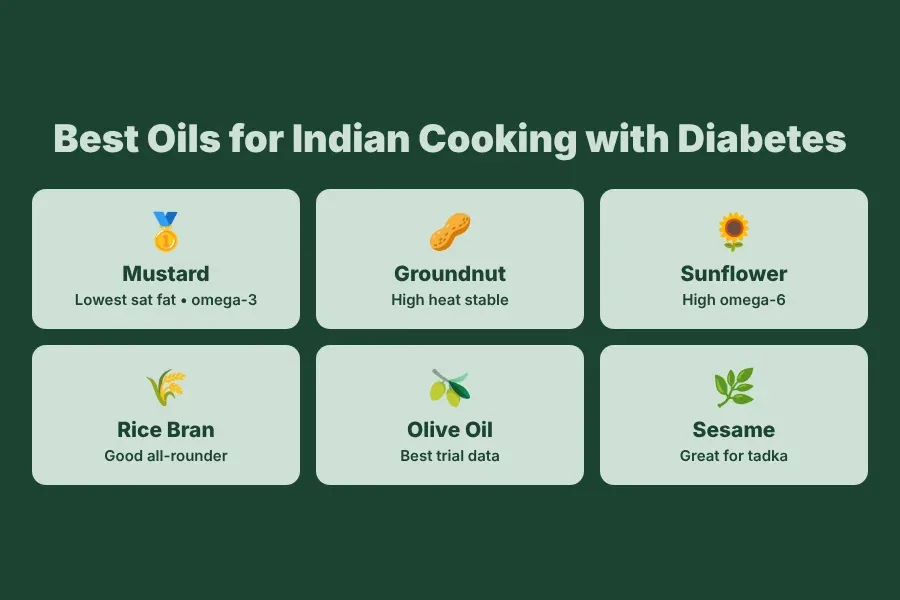
For an Indian kitchen, the best choices are liquid plant oils low in saturated fat and free of trans fat, such as mustard, groundnut, sesame, rice bran, sunflower or soyabean oil. The American Heart Association suggests choosing oils with less than 4 grams of saturated fat per tablespoon and no partially hydrogenated fat, and its list includes groundnut, soybean, sunflower, safflower, corn and olive oil, with rice bran and sesame as healthy speciality options.
In the PREDIMED trial, roughly half of the 7,447 high-risk adults had type 2 diabetes, and the group eating a Mediterranean diet with extra-virgin olive oil had a lower combined rate of heart attack, stroke or cardiovascular death than the group advised to cut fat (hazard ratio 0.69). That result came from a whole eating pattern plus about a litre of olive oil a week per household, not from the oil alone.
Three rules cover most kitchens:
- Choose liquid over solid. Vanaspati, palm oil, ghee and coconut oil are high in saturated or trans fat; the oils listed above are not.
- Rotate two oils rather than relying on one. India’s ICMR-NIN Dietary Guidelines (2024) advise moderating oils high in omega-6, and a cardiologist-co-authored review in the Indian Heart Journal suggests blending oils to balance fatty acids and antioxidants; rotating oils has not been tested in outcome trials.
- Measure the total. Every oil carries about 9 calories per gram, and ICMR-NIN sets a daily limit for all of them combined.
Does cooking oil affect blood sugar?
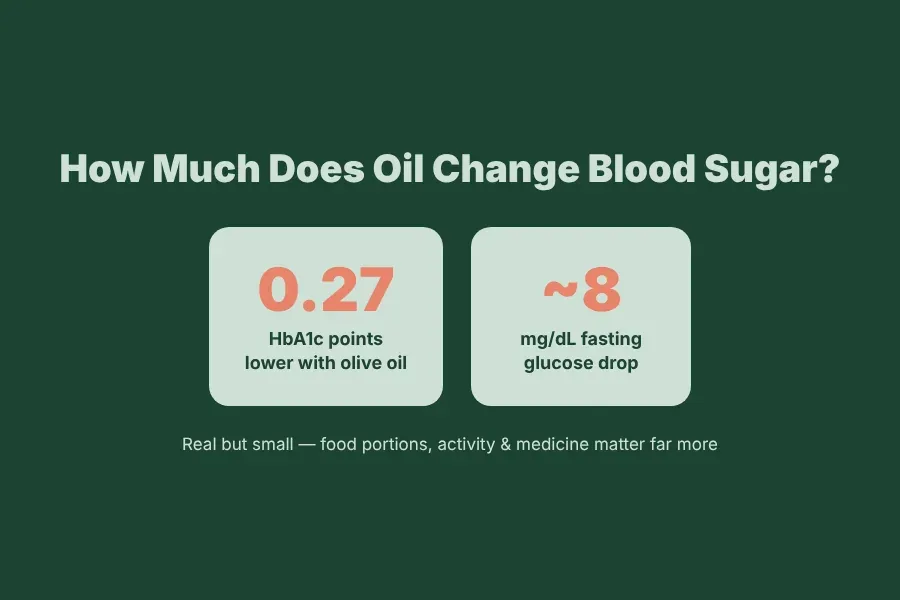
Yes, but only slightly. In a meta-analysis of 102 controlled feeding trials, Imamura and colleagues found that replacing 5% of daily calories from carbohydrate with polyunsaturated fat lowered HbA1c by about 0.11 percentage points; swapping in monounsaturated fat lowered it by about 0.09.
For olive oil specifically, a 2017 meta-analysis in Nutrition & Diabetes found that in people with type 2 diabetes, HbA1c fell about 0.27 points more with olive oil than in control groups, and fasting glucose about 0.44 mmol/L (roughly 8 mg/dL) more. In the few small trials comparing olive oil directly with PUFA-rich oils (four trials, 74 people), olive oil lowered fasting glucose more (about 0.85 mmol/L, or 15 mg/dL), but the HbA1c difference was not statistically clear.
These trials replaced carbohydrate with fat or compared olive oil with mixed control diets; swapping one liquid oil for another at the same amount is likely to change HbA1c even less. Even the largest effect above would take an HbA1c of 8.0% only to about 7.7–7.9%. Food choices, portions, activity and medicines move it far more. Claims that an oil “stabilises blood sugar” or “controls diabetes” overstate the evidence. On 5 October 2026, Google’s AI Mode table described extra-virgin olive oil as one that “significantly improves fasting blood sugar, HbA1c, and blood pressure” for this search; the trial data show a real but small effect.
Oil choice moves cholesterol more than blood sugar, provided the swap replaces saturated fat. The AHA’s 2026 dietary guidance states that replacing saturated fat with polyunsaturated fat, and to a lesser extent monounsaturated fat, lowers LDL cholesterol, which it calls a causal risk factor for cardiovascular disease. People with diabetes have higher cardiovascular risk, so lower LDL is the main payoff of the switch.
Indian cooking oils compared
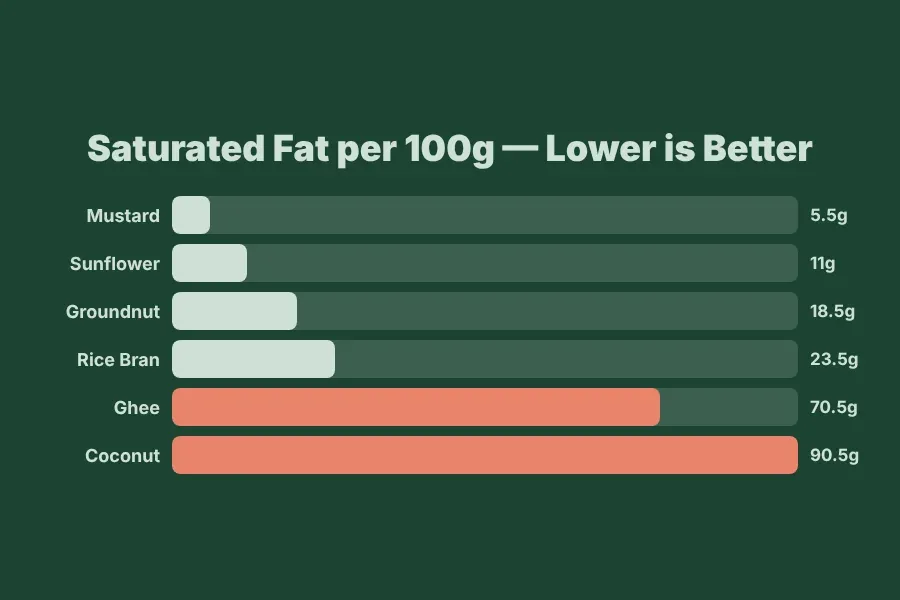
Mustard oil has the least saturated fat and the most omega-3 of the common Indian oils, while palmolein, ghee and coconut oil are the most saturated. The figures below are read from the fatty-acid chart (Figure 7.2) in the ICMR-NIN guidelines, so treat them as approximate (grams per 100 g of oil).
| Oil or fat | Saturated | Mono-unsaturated | Omega-6 | Omega-3 | Passes AHA’s <4 g saturated fat per tbsp?* |
|---|---|---|---|---|---|
| Mustard | 5.5 | 67 | 15.5 | 12 | Yes |
| Safflower | 9 | 14 | 77 | 0 | Yes |
| Sunflower | 11 | 26 | 63 | 0 | Yes |
| Sesame (til) | 15.5 | 41.5 | 42.5 | 0.5 | Yes |
| Soyabean | 15.5 | 24 | 55 | 5.5 | Yes |
| Corn | 16.5 | 33.5 | 49.5 | 0.5 | Yes |
| Groundnut | 18.5 | 54 | 27.5 | 0 | Yes |
| Rice bran | 23.5 | 44 | 32 | 0.5 | Yes |
| Cottonseed | 28 | 19.5 | 52.5 | 0.5 | Borderline |
| Palmolein | 44.5 | 43.5 | 11.5 | 0.5 | No |
| Ghee | 70.5 | 26.5 | 2 | 1 | No |
| Coconut | 90.5 | 8 | 1.5 | 0 | No |
*Our calculation: 1 tablespoon ≈ 14 g, so the AHA cut-off works out to roughly 28 g saturated fat per 100 g. Olive and canola oil are not in the ICMR chart; both are low in saturated fat and appear on the AHA list.
What labels often leave out:
- Rice bran oil is more saturated than groundnut or sesame oil. It passes the AHA cut-off (about 3.3 g per tablespoon), but it is not the lowest-saturated-fat choice its “heart” marketing suggests.
- Some “blended” and economy oils contain palmolein. Read the ingredient list; if palm or palmolein comes first, the blend is closer to the bottom of this table than the top.
- Mustard oil contains erucic acid. The same Indian Heart Journal review notes that the heart concerns came from rat studies and have not been shown in humans.
Safflower, sunflower, soyabean and corn oils are high in omega-6. Harvard Health notes there is scant evidence for social-media claims that seed oils cause diabetes or heart disease, while ICMR-NIN advises moderating high omega-6 oils. Use them, but pair them with mustard, groundnut or olive oil rather than relying on a single high omega-6 oil.
Which oil for which kind of Indian cooking
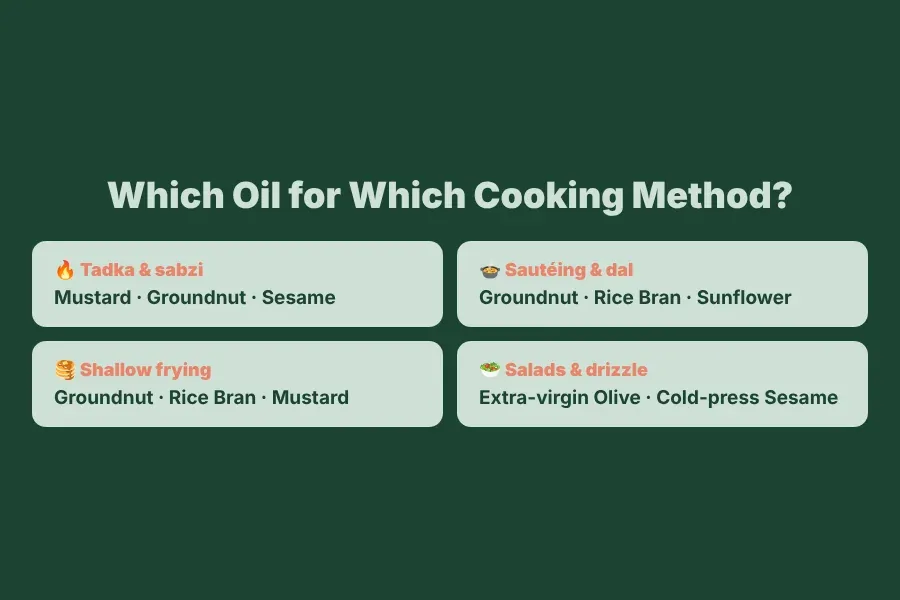
Match the oil to the cooking temperature and the flavour you want. The Indian Heart Journal review describes mustard oil as relatively stable at high cooking temperatures and says it can be a preferred choice, particularly cold-pressed.
| Cooking job | Good choices | Notes |
|---|---|---|
| Tadka and everyday sabzi | Mustard, groundnut, sesame | Mustard and sesame add strong flavour, so small amounts are enough |
| Sautéing, roasting, dal | Groundnut, rice bran, sunflower, olive oil | Any oil from the list works at these temperatures |
| Shallow frying (paratha, cheela, tikki) | Groundnut, rice bran, mustard | Use a measured spoon, not a pour |
| Deep frying | Groundnut or rice bran, and rarely | The AHA does not recommend deep-fat frying as a healthy method |
| Salads, chutneys, drizzling | Extra-virgin olive oil, cold-pressed sesame | Flavour without heat |
In North and East Indian kitchens, a common pairing is mustard plus groundnut; in the South, sesame plus groundnut; for neutral flavour, rice bran or sunflower plus mustard. Alternate them week by week, or use one for tadka and the other for everything else.
Cold-pressed (kachi ghani) vs refined: ICMR-NIN says cold-pressed oils keep more natural antioxidants but, like crude oils, can carry undesirable compounds; refining removes many of those but strips some antioxidants and adds preservatives. No outcome trials show either form is better for the heart, so choose by fatty-acid profile first and processing second.
Is olive oil or avocado oil worth the price?
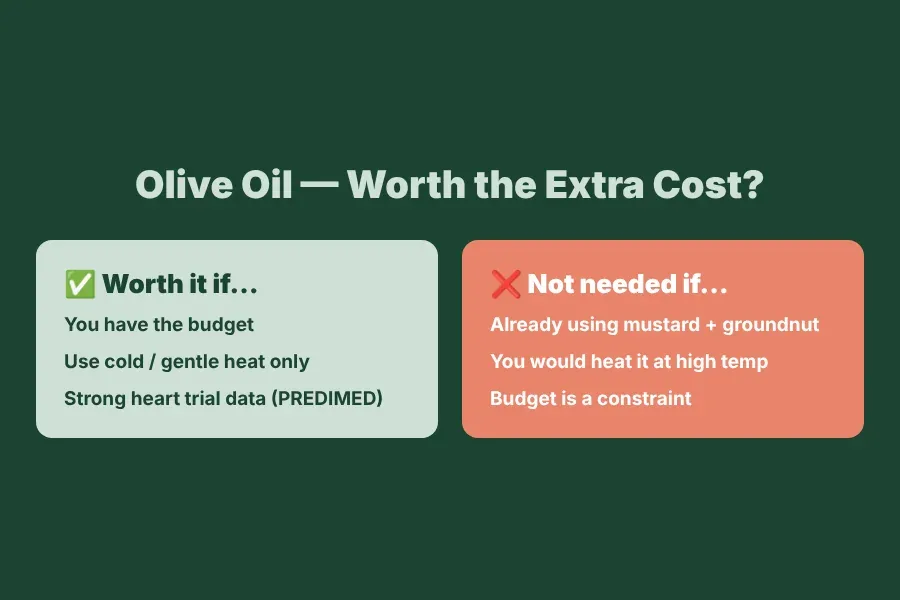
Not necessary, but olive oil is a good addition if your budget allows. Extra-virgin olive oil has the strongest trial record of any single oil, from PREDIMED and the olive-oil meta-analysis above. Those studies were mostly Mediterranean diets, and the comparison groups were mostly low-fat diets or other fats, rarely mustard or groundnut oil, so they do not show that olive oil beats Indian oils used the same way.
Avocado oil is low in saturated fat, but it has far fewer outcome studies and usually costs more than Indian oils. If you buy one imported oil, use extra-virgin olive oil cold or for gentle cooking, and keep an Indian oil for the tadka.
What about ghee, coconut oil and vanaspati?
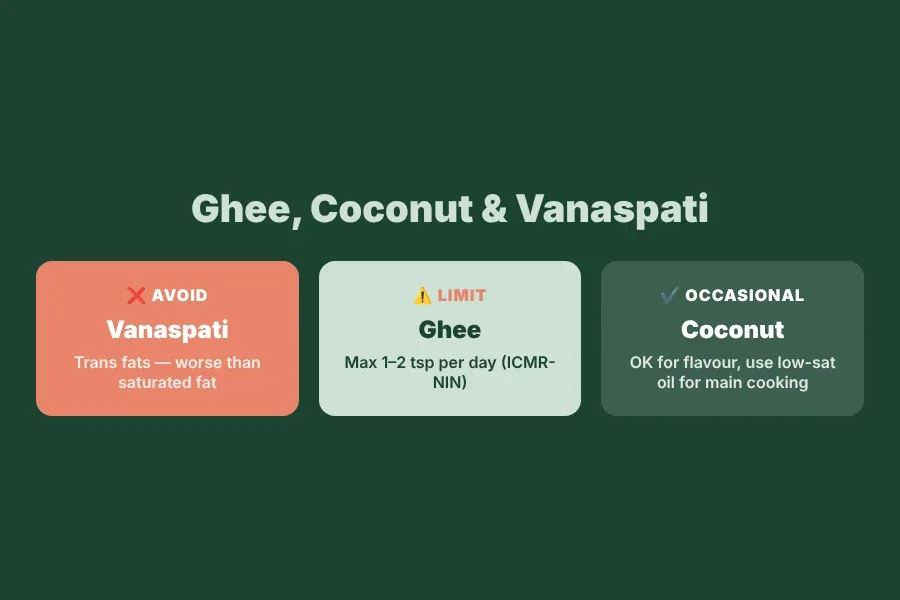
Use ghee and coconut oil sparingly and avoid vanaspati. Ghee is about 70% saturated fat and coconut oil about 90%, so both raise LDL cholesterol more than liquid oils do, and vanaspati can also carry trans fat.
- Ghee and butter: ICMR-NIN advises limiting ghee or butter to 1–2 teaspoons a day, or avoiding them if possible. A teaspoon on dal or roti for flavour fits within that; cooking the whole meal in ghee does not.
- Coconut oil: a meta-analysis in Circulation found coconut oil raised LDL cholesterol by about 10.5 mg/dL compared with non-tropical vegetable oils (HDL also rose, by about 4 mg/dL) and did not significantly change blood sugar markers. Coastal cooking can keep it for flavour while using a lower-saturated oil for most dishes.
- Vanaspati and partially hydrogenated fats: ICMR-NIN says trans fats can increase the risk of heart disease and stroke and are more harmful than saturated fat, and advises against using vanaspati as a cooking medium. Bakery snacks and namkeen fried in shortening are a common hidden source.
How much cooking oil per day is right with diabetes?
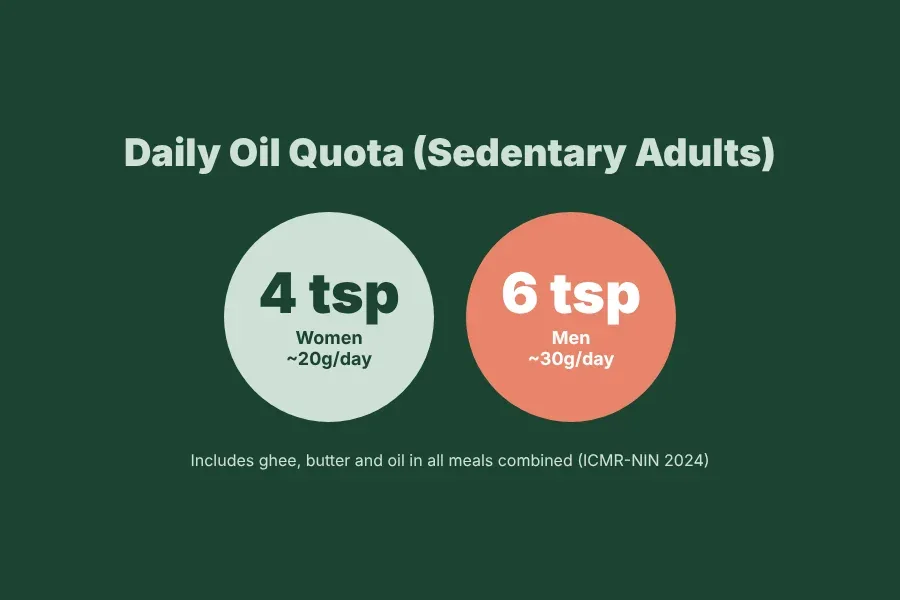
For most adults with a desk-bound routine, the oils-and-fats chapter of ICMR-NIN’s guidelines puts the limit at about 20 g a day for women and 30 g a day for men, or roughly 4 and 6 teaspoons (ICMR’s sample balanced-diet table allows a sedentary woman up to 25 g). Moderately active adults can go up to about 30 g (women) and 40 g (men), and ICMR-NIN caps a 2,000-calorie day at 27–30 g. Those figures include any ghee or butter. In household terms, a sedentary couple (one woman, one man) would use about 1.5 kg of oil and ghee a month, roughly 1.6–1.7 litres, before counting food eaten outside.
Extra oil adds calories quickly, and weight matters for both glucose and heart health. Ways to stay within the limit:
- Pour the day’s oil into a small marked bottle each morning and cook only from that.
- Measure with a teaspoon instead of pouring from the can.
- Cook sabzi covered so vegetables steam in their own moisture, and use a non-stick or well-seasoned iron pan.
- Count the oil in pickles, parathas and restaurant food toward the same daily total.
If you are on a doctor- or dietitian-prescribed plan, follow their number; the ICMR figures are population guidance, not a personal prescription.
Is it safe to reuse frying oil?
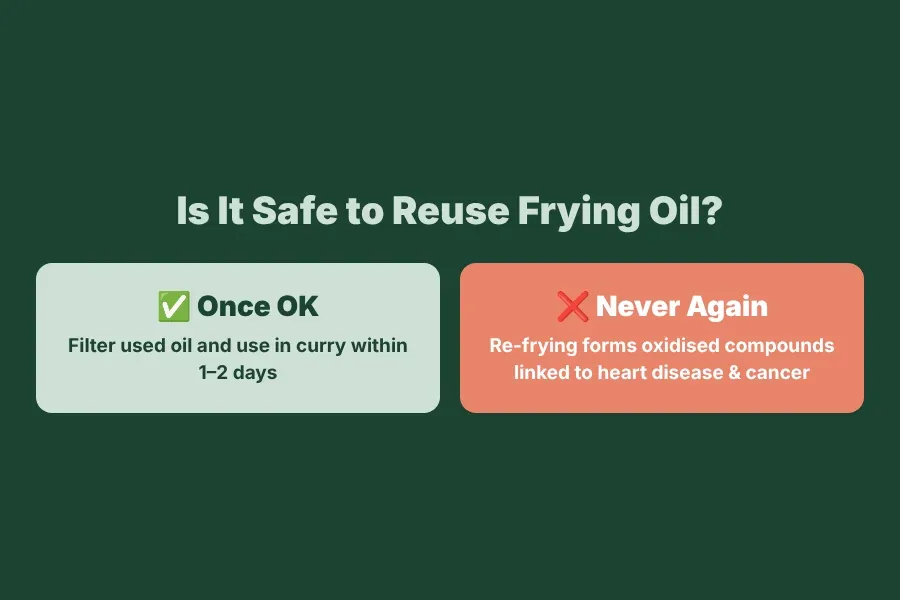
Not for frying again. ICMR-NIN says repeatedly heated oil forms oxidised compounds that may increase the risk of heart disease and cancer. Its household rule: oil used once for frying can be filtered and used for curry, within a day or two, but should not be used for frying a second time, and used oil should not be stored long.
The AHA is stricter, advising against reusing or reheating any cooking oil. For restaurants and food businesses, India’s food regulator FSSAI sets a limit of 25% total polar compounds, beyond which oil must not be used. At home, discard oil that smokes in the pan or smells rancid, as the AHA advises.
Your cooking oil checklist
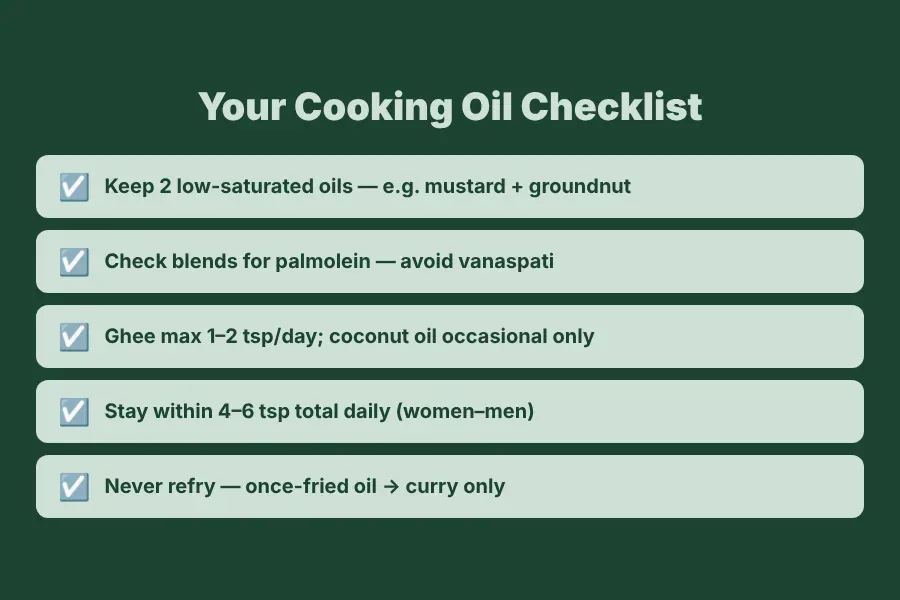
Choose liquid, low-saturated oils, rotate two of them, measure every spoon, and fry once.
- Keep two low-saturated oils with different profiles, such as mustard and groundnut.
- Check blends for palmolein and avoid vanaspati.
- Keep ghee to 1–2 teaspoons a day and coconut oil occasional.
- Stay at or under about 4 teaspoons (women) or 6 teaspoons (men) a day if you are not very active.
- Never refry; use once-fried oil only for curry within a day or two.
- If you are moving away from ghee, vanaspati, palm or coconut oil, expect lower LDL cholesterol; manage blood sugar mainly through your meals as a whole.
For meal ideas that put this into practice, see our diabetes-friendly Indian meals, the Indian diet plan for diabetes, our list of everyday foods for blood sugar and a diabetes-friendly Mediterranean week.
If you would like a plan built around your own reports, food habits and family kitchen, HealthyWayFit offers medically supervised coaching for people managing diabetes.
Note: This article is general information, not medical advice.
If you have heart disease, kidney disease or take medicines for diabetes, cholesterol or blood pressure, talk to your doctor or dietitian before changing your diet.
Written by Kirti, founder of HealthyWayFit. Last updated: 5 October 2026.



