By Kirti, Founder & Serial Entrepreneur, HealthyWayFit · Last updated 23 October 2026
US research comparison, checked October 2026. We have not been members of either program. HealthyWayFit sells one-on-one lifestyle support, so we have a commercial interest in this subject.
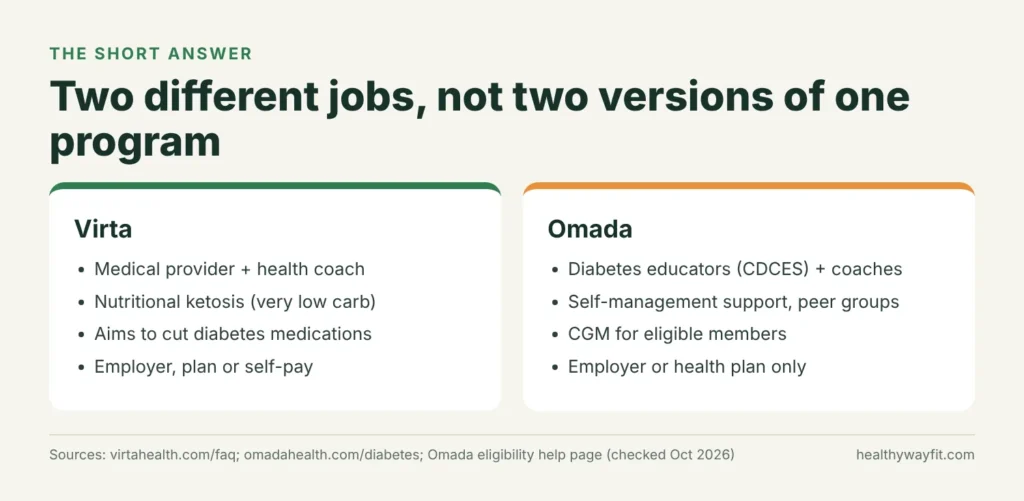
Omada vs Virta comes down to two different kinds of help. Virta is a medical treatment: a Virta medical provider manages your diabetes care and medications while a coach helps you follow a very low-carb eating plan aimed at nutritional ketosis. Omada is self-management support: diabetes educators, coaches, peer groups and connected devices, including a CGM for eligible members. You can pay for Virta yourself; Omada needs employer or health-plan coverage.
Caution: This article is for informational purposes only and does not constitute medical advice.
Always consult a qualified healthcare professional before making changes to your diet, exercise routine or medication.
How do Omada and Virta compare at a glance?
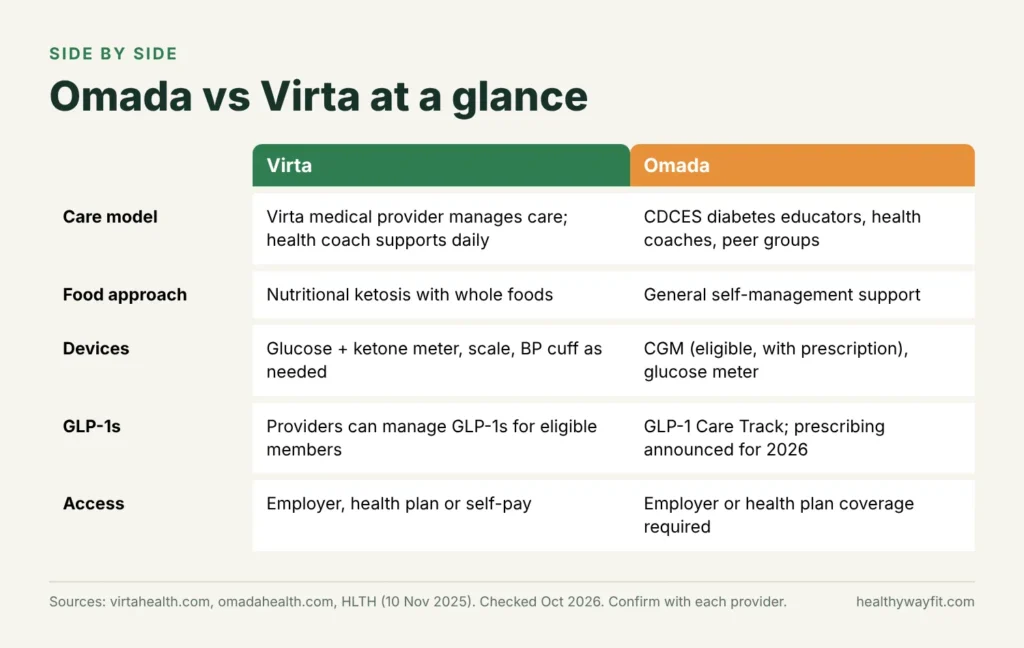
Virta is built around a medical provider who adjusts your diabetes medications as a strict low-carb diet lowers your glucose. Omada is built around education and coaching that help you manage diabetes day to day, while your own clinician usually keeps routine prescribing. The table below sets out the differences that decide which one fits.
| Virta | Omada | |
|---|---|---|
| Who leads your care | A Virta medical provider, plus a health coach | Certified Diabetes Care and Education Specialists (CDCES) and health coaches |
| Food approach | Nutritional ketosis using whole foods; no calorie counting | General diabetes self-management support |
| Main goal | Lower glucose while reducing diabetes medications | Better day-to-day control and habits |
| Devices | Glucose and ketone meter, connected scale, blood pressure cuff as needed | CGM for eligible members with a prescription; glucose meter |
| GLP-1 medications | Providers can manage GLP-1s for eligible members | GLP-1 Care Track since 2023; prescribing announced for 2026 |
| How you join | Employer, health plan or self-pay | Clinical eligibility plus employer or health-plan coverage |
| Self-pay price | $299/month plus a $250 one-time fee | No public self-pay route found |
Sources for the table: the Virta FAQ, the Omada for Diabetes page and the Omada eligibility help page, all checked in October 2026. Services change, so confirm the details with each provider before you enrol.
How are the two programs built differently?
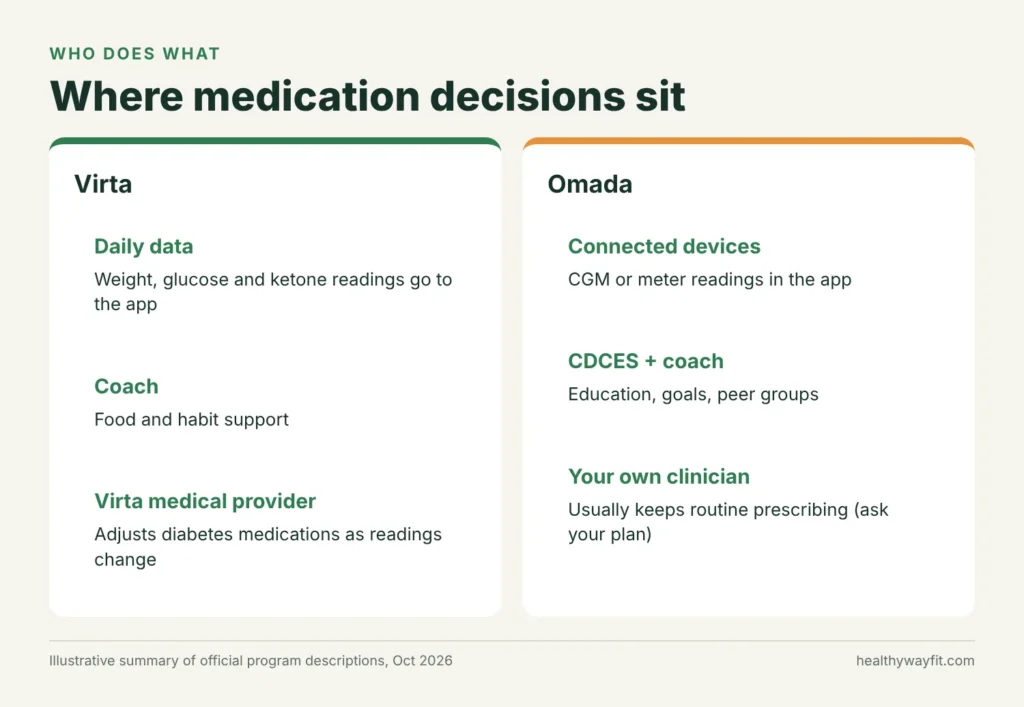
The biggest difference is who changes your medications. In Virta, a Virta medical provider manages your diabetes care at the Virta Clinic, so dose changes happen inside the program as your readings improve. In Omada, the educators and coaches focus on knowledge, habits and monitoring, and prescribing usually stays with your own doctor.
The Virta FAQ describes the treatment as “nutritional ketosis using whole, real foods” and says it does not expect members to count or restrict calories. Enrolment includes a telemedicine visit with the medical provider, followed by annual check-ups, and you send daily weight, glucose and ketone readings through the app. That daily data is what lets the provider lower medications safely when carbohydrate restriction brings glucose down quickly.
Omada’s diabetes page describes support from CDCES-qualified educators and professional health coaches, diabetes-specific peer groups, and connected devices. It does not prescribe one eating pattern on that page. If you want a program that leaves your food choices more open and works alongside your current doctor, that is a meaningful difference from Virta’s single, strict protocol.
Ask Omada, through your benefit, who handles a medication change if your glucose drops. Ask Virta what happens with your existing doctor and how often you will speak to the medical provider. Our Omada diabetes review covers the questions to put to Omada in more detail.
What does the research show for Virta?
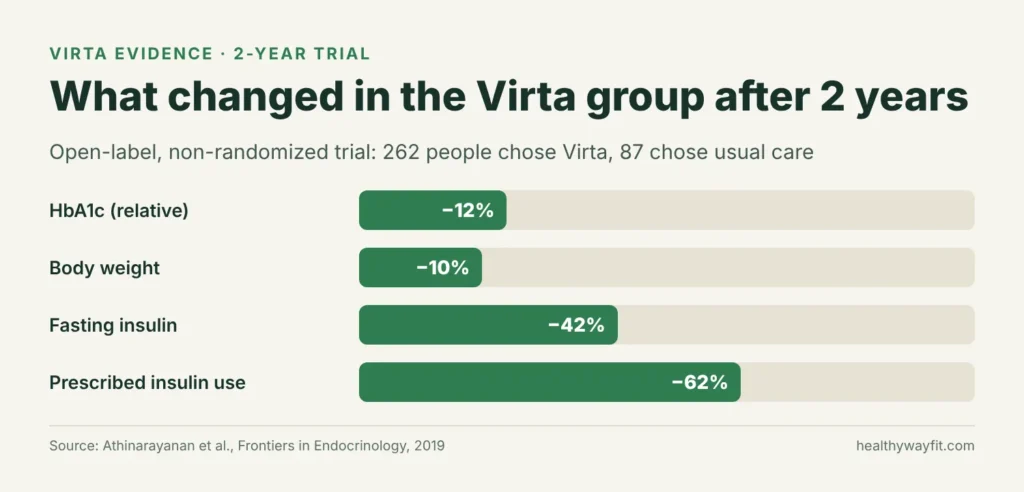
Virta’s main evidence is a two-year clinical trial in which people chose either Virta or usual care. The Virta group’s HbA1c fell 12% in relative terms and weight fell 10%, and 53.5% met Virta’s reversal definition at two years. Because people picked their own group, the trial cannot prove the program caused those changes.
The study, by Athinarayanan and colleagues in Frontiers in Endocrinology (2019), followed 262 adults with type 2 diabetes in the Virta group and 87 in usual care. It was open-label and non-randomized. At two years, the Virta group’s average HbA1c had dropped from 7.7%, fasting insulin was down 42%, and prescribed insulin use was down 62%. Use of glucose-lowering drugs other than metformin fell from 55.7% to 26.8%. The usual-care group showed no significant change in these measures.
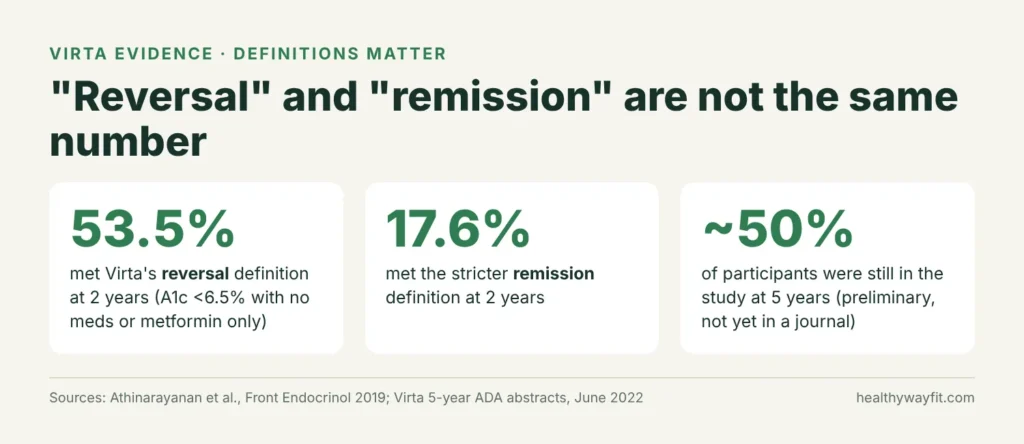
Two definitions in that paper matter when you compare marketing claims. “Reversal” meant an HbA1c below 6.5% while taking no diabetes medication or metformin only; 53.5% reached it. “Remission”, which requires no glucose-lowering medication at all, was reached by 17.6%. A program quoting the first number is not quoting the second.
Virta also presented preliminary five-year results at the American Diabetes Association’s Scientific Sessions in June 2022. According to Virta’s summary of those abstracts, nearly half of participants were still in the study at five years, about a third of those who completed it had HbA1c below 6.5% with no diabetes drugs or metformin only, and about a fifth met the stricter remission definition. These figures come from conference abstracts and a company summary, not a full journal paper, and they describe the people who stayed, not everyone who started.
What does the research show for Omada?
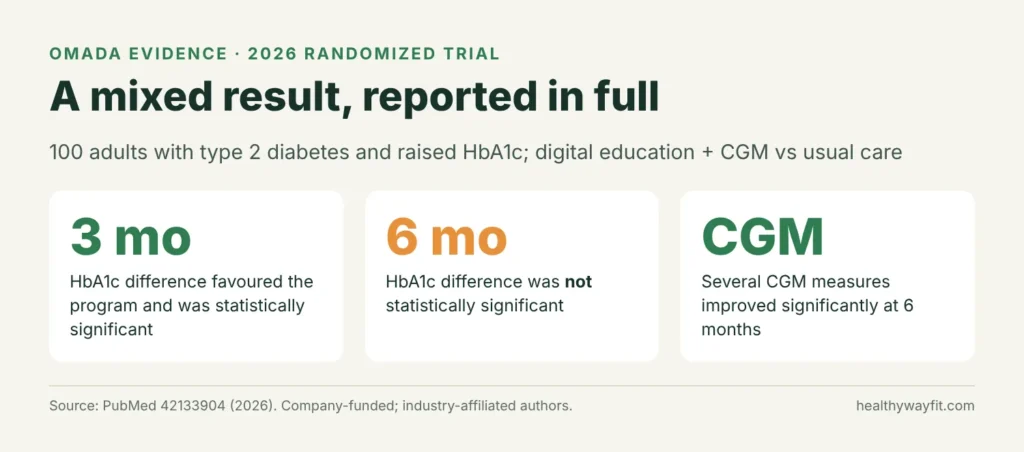
Omada’s most rigorous recent evidence is a 2026 randomized trial of digital diabetes education and support plus a CGM in 100 adults with type 2 diabetes. HbA1c improved significantly more than usual care at three months, but the difference was not statistically significant at six months. Several CGM measures did improve significantly at six months.
That 2026 trial excluded people using mealtime insulin, was company-funded and had industry-affiliated authors. A randomized design is a strength, because it compares like with like. The mixed HbA1c result is the honest headline, and it should be reported alongside the positive CGM findings rather than replaced by them.
Omada also cites a 2024 retrospective study of HbA1c in commercially insured members. Observational data like this can show change over time, but it cannot isolate how much of the change came from the program.
On its diabetes page, Omada says 76% of members meet HbA1c reduction goals and states that “we do not claim that these are typical results.” Treat company figures and member satisfaction surveys as different from trial results.
What the two evidence bases can and cannot tell you: Virta has longer follow-up and larger medication changes, but from a non-randomized design. Omada has a randomized trial, but a small one with a short-lived HbA1c difference. Neither has been tested head to head against the other, so no study shows one program works better than the other.
Which program uses a CGM?
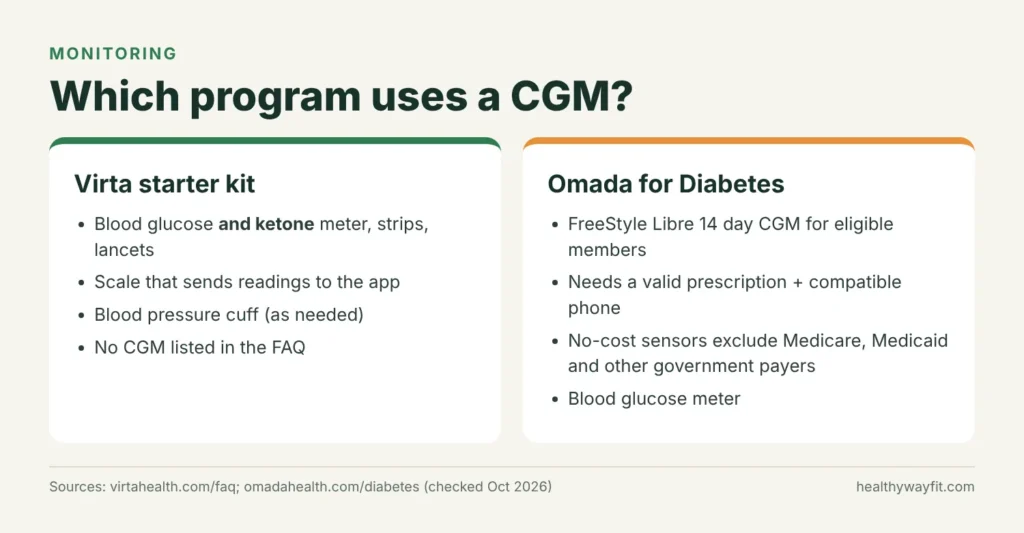
Omada offers a continuous glucose monitor to eligible members; Virta’s starter kit, as described in its FAQ, does not include one. Virta instead provides a meter that tests both blood glucose and ketones, because confirming ketosis is part of its protocol, plus a connected scale and a blood pressure cuff when needed.
Omada’s diabetes page lists the Abbott FreeStyle Libre 14 day system for “eligible participants with a valid prescription and compatible smartphone.” It also says the no-cost sensors exclude Medicare, Medicaid and other government payers. If you are covered through one of those, ask what monitoring you will actually receive.
A CGM shows how specific meals and activities move your glucose across the day, which some people find motivating. Ketone testing shows whether you are in the nutritional ketosis Virta aims for. They answer different questions, and the right one depends on the program’s method. Our CGM guide explains what the readings can and cannot tell you.
How do Omada and Virta handle GLP-1 medications?
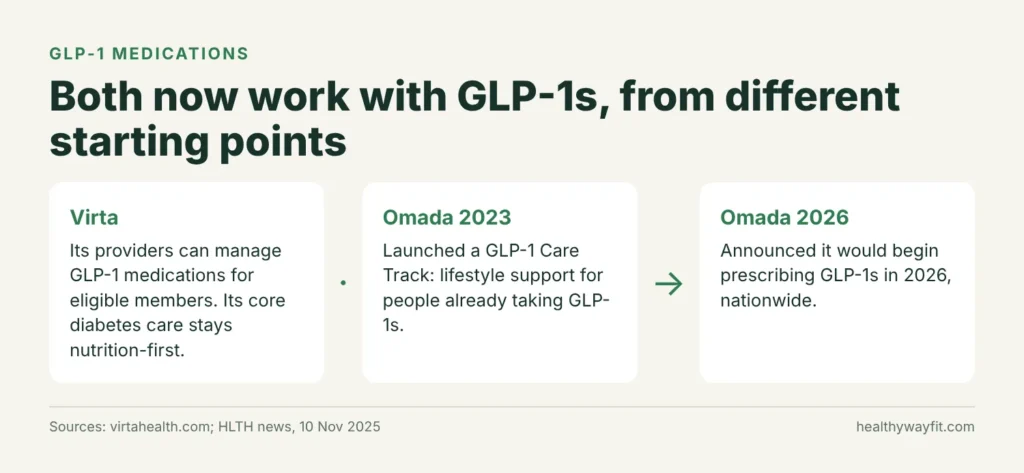
Both programs now work with GLP-1 medications such as semaglutide, from different starting points. Virta’s homepage says its providers can manage GLP-1 medications for eligible members, while its diabetes care stays nutrition-first. Omada launched a GLP-1 Care Track in 2023 to support people already taking these drugs, and announced it would begin prescribing them in 2026.
The Omada announcement was reported by HLTH on 10 November 2025, which said prescribing would have nationwide availability and that the GLP-1 Care Track had supported more than 100,000 members. Whether you can get a prescription through your own Omada benefit depends on your employer or plan, so check that directly.
If you already take a GLP-1, ask each program whether it expects you to continue, reduce or stop it, and who makes that call. Do not stop a GLP-1 on your own. Our comparison of Virta Health vs Ozempic looks at that choice more closely.
What do Omada and Virta cost, and can you join without an employer?
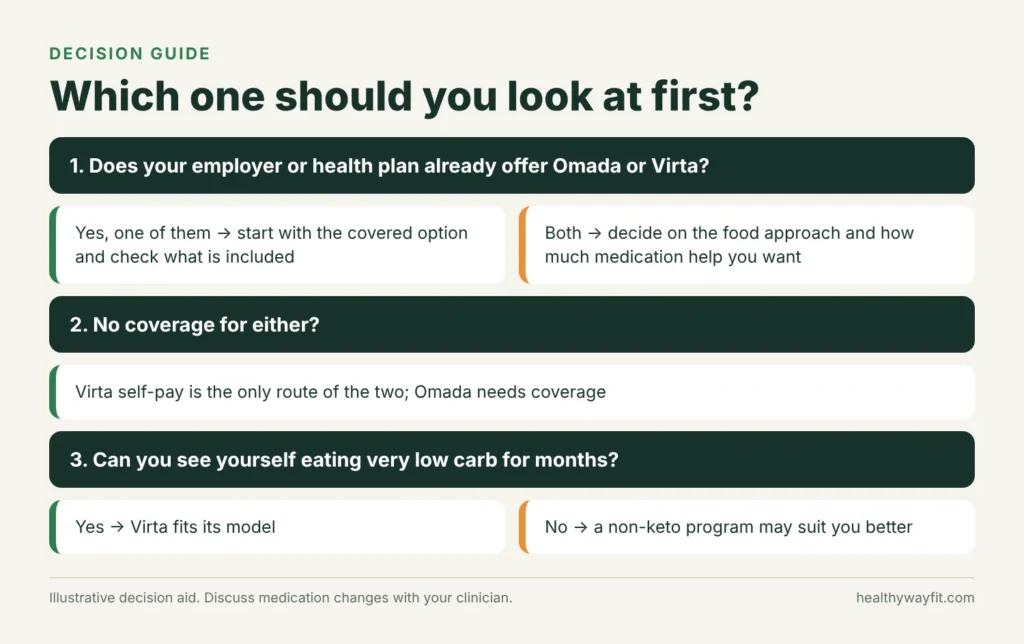
Virta can be bought directly: its self-pay price is $299 a month plus a one-time $250 initiation fee, which makes $3,838 for the first year. Omada says clinical eligibility and coverage through an employer or health plan are required, and we found no public self-pay route.
The Virta price comes from the Virta Self-Pay Costs FAQ, as recorded in our Virta Health cost guide in October 2026. The Virta FAQ adds that there is no fee to apply, that members covered through an employer-sponsored plan pay no treatment cost, and that its member assistance program offers up to 60% off the annual cost, with no monthly payment option for that discount. Prices change, so check the current figure before you sign up.
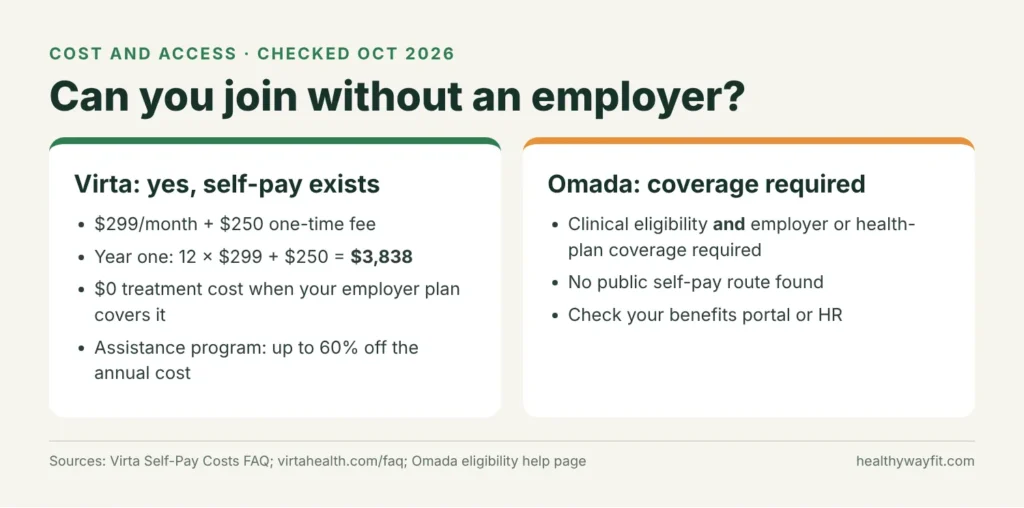
For Omada, the practical route is your benefits portal or HR team. If Omada is listed, ask whether the diabetes program, the CGM and any GLP-1 support are all part of your benefit, and what happens if you change jobs or plans.
Who is each program best for?
Virta fits people who want medical supervision to reduce diabetes medications and who are willing to eat very low carb for the long term. Omada fits people who already have it through work or their plan and want coaching, education and CGM-based feedback without changing their whole diet or care team.
Virta is likely the better fit if you:
- want a provider who actively adjusts your diabetes medications, including insulin, as your glucose changes
- are willing to follow a strict low-carb, ketosis-focused eating pattern
- have no employer coverage for either program and are prepared to self-pay
- care most about the longest follow-up data in this category, while accepting it is non-randomized
Omada is likely the better fit if you:
- already have Omada through your employer or health plan, at little or no cost
- want a CGM to learn how your own meals affect your glucose
- prefer flexible food choices to a single prescribed diet
- want support alongside your current doctor rather than a new prescriber
If neither profile matches, our guide to Virta Health alternatives and our US online diabetes program guide compare other routes, including CGM-led and non-keto programs such as Level2.
When should you talk to your doctor before enrolling?
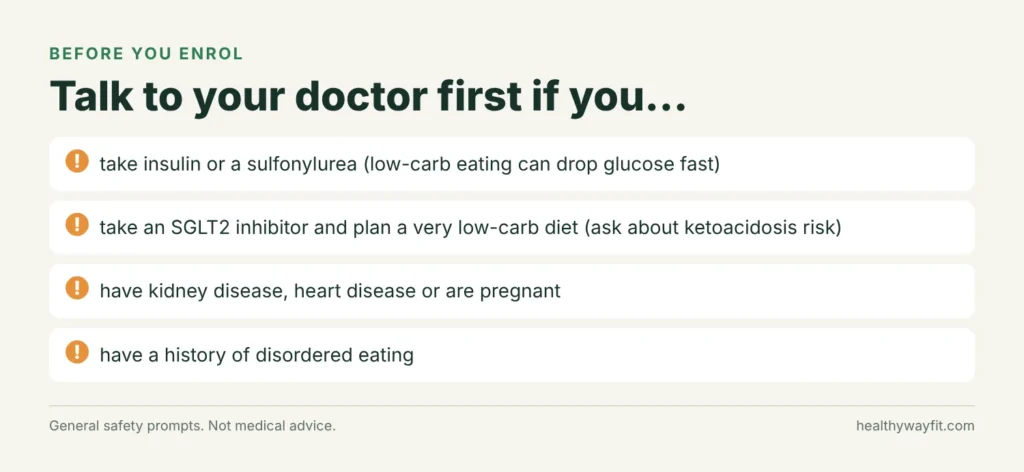
Talk to your doctor before starting either program if you take insulin or a sulfonylurea, take an SGLT2 inhibitor, have kidney or heart disease, are pregnant, or have a history of disordered eating. Cutting carbohydrates sharply can lower glucose fast, and some medicines need adjusting before the diet changes, not after.
Insulin and sulfonylureas can cause low blood sugar when food intake drops. SGLT2 inhibitors carry an FDA warning about ketoacidosis, which very low-carb eating may make more likely, so anyone on these drugs who is considering a ketogenic plan needs a specific conversation with their prescriber. Virta’s onboarding is designed to manage these medicines, but your existing doctor should still know what you are doing.
Keep your current appointments and prescriptions until you have a clear, coordinated plan. Enrolling in a program is not a reason to stop any treatment on your own.
What if neither program suits you?
If you have no coverage, do not want a ketogenic diet, or want more personal contact than an app-based model offers, look at programs built around one-on-one support. Choose by the help you need, not by brand: who adjusts medications, how often you speak to a person, and how flexible the food plan is.
HealthyWayFit offers private one-on-one coaching with senior professionals, weekly calls and daily check-ins, built around your food preferences and routine. It is not a medical prescriber, so medication decisions stay with your doctor. You can see how the approach works in our free diabetes training.
Frequently asked questions
Is Omada or Virta better for type 2 diabetes? Neither has been shown to be better than the other, because no study has compared them directly. Virta suits people who want supervised medication reduction through a very low-carb diet; Omada suits people with coverage who want coaching, education and CGM feedback.
Can I get Omada without insurance? Omada’s eligibility page says coverage through an employer or health plan is required, and we found no self-pay option as of October 2026.
Does Virta use a continuous glucose monitor? Virta’s FAQ lists a glucose and ketone meter, a connected scale and a blood pressure cuff as needed. It does not list a CGM.
Do I have to eat keto on Virta? Virta’s treatment is designed to produce nutritional ketosis, so a very low-carbohydrate eating pattern is central to the program.
The bottom line on Omada vs Virta
Pick Virta if you want a medical program that actively reduces your diabetes medications and you can commit to very low-carb eating, whether through your employer or at $299 a month. Pick Omada if it is already in your benefits and you want coaching and CGM feedback alongside your own doctor. Check your benefits first: the covered option costs least, and the best program is the one you will keep following.