Written by Kirti, Founder & Serial Entrepreneur, HealthyWayFit. Last updated: October 2026.
This article is for informational purposes only and does not constitute medical advice. If you are managing diabetes, please consult your healthcare provider or a registered dietitian before making dietary changes.
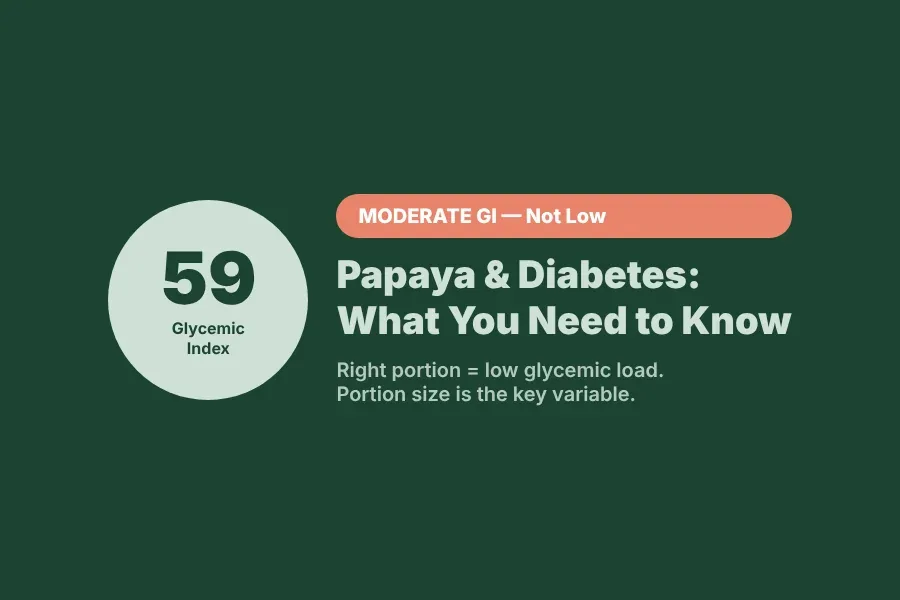
Most articles you’ll find on “papaya and diabetes” make the same error: they call papaya a low-GI fruit. It isn’t. Papaya has a glycemic index of 59–60, which puts it firmly in the moderate GI category — the same range as mango and sweet corn.
That correction matters, because the low-GI claim leads people to think they can eat papaya freely, when portion size is still the crucial variable.
But here’s what those articles also miss: moderate GI does not mean diabetics can’t eat papaya. The glycemic load calculation, the green-versus-ripe distinction, and what you eat papaya alongside all tell a more nuanced story than the GI number alone.
So — is papaya good for diabetes? The honest answer is: yes, in the right portions and context, and no if you eat it the way most people do at fruit chaat stalls. This article walks through the actual research so you can make that call for your own plate.
How Much Papaya Can a Person with Diabetes Eat?
Before we get into the science, here’s the practical rule most readers came for.
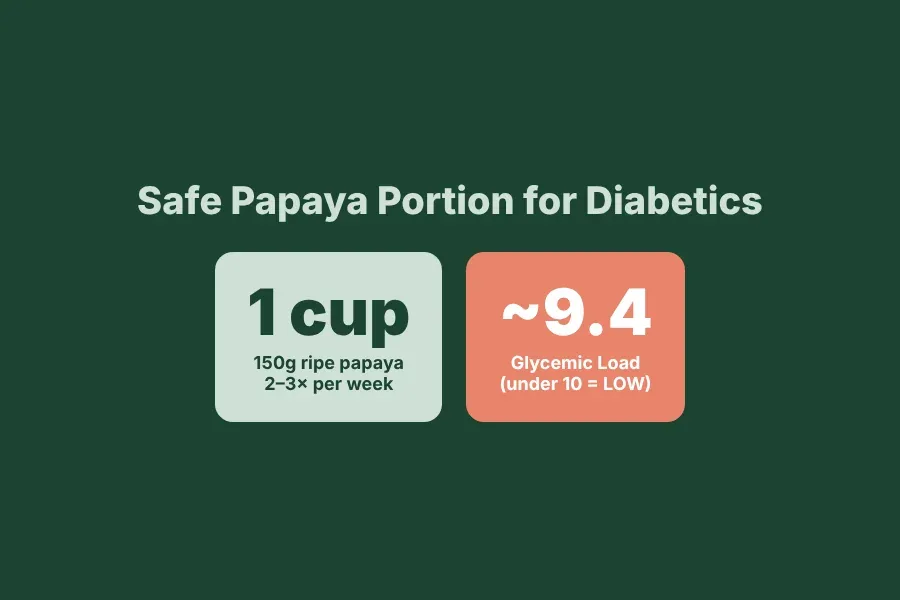
One cup (150g) of ripe papaya, 2–3 times per week, is a reasonable portion for most people managing Type 2 diabetes. That’s roughly a medium-sized slice — not a full bowl.
The reason this number works comes down to glycemic load, which is a better real-world predictor of blood sugar response than GI alone.
Glycemic load (GL) = (GI × grams of net carbs) ÷ 100
For 150g of ripe papaya:
- Net carbs: approximately 16g
- GL = (59 × 16) ÷ 100 = ~9.4
A GL under 10 is considered low. So despite papaya’s moderate GI, a standard serving produces a low glycemic load — comparable to a small apple or a cup of grapes.
The practical rules that follow from this:
- Eat papaya as part of a meal or with protein and fat (yogurt, a handful of nuts), not on its own. Fat and protein slow gastric emptying and blunt the glucose spike.
- Keep the portion to one cup. Double the portion and you roughly double the glycemic load.
- Green (unripe) papaya has different properties from ripe — covered separately below.
- Your glucometer tells you the truth. If your blood sugar spikes 2 hours after eating papaya in the portion and context you ate it, that’s more reliable data than any study average.
What Is Papaya’s Actual Glycemic Index?
The GI of a food is measured by feeding 50g of available carbohydrate from that food to a test group, measuring blood glucose for 2 hours, and comparing the area under the curve to pure glucose (GI = 100).
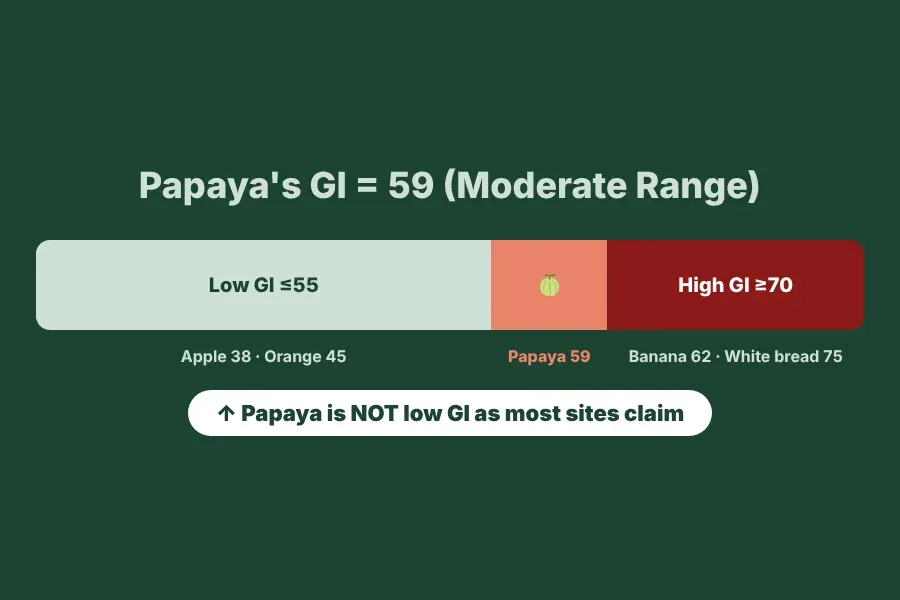
Published GI values for papaya range from 56 to 60 depending on the study population, ripeness level, and measurement method. The University of Sydney’s GI database — the most cited reference source — lists ripe papaya at approximately 59.[3]
The international classification system:
- Low GI: ≤ 55
- Moderate GI: 56–69
- High GI: ≥ 70
Papaya at 59 sits in the moderate tier. It is worth noting that even this classification isn’t binary — a GI of 59 is much closer to the low end of moderate than to the high end, and as the glycemic load calculation shows, a standard serving is low-impact in practice.
The competing content that calls papaya “low GI” appears to be rounding down or using outdated references. The moderate GI classification is more accurate.
Papaya’s Nutritional Profile
Per 100g of ripe papaya:
| Nutrient | Amount |
|---|---|
| Calories | 43 kcal |
| Carbohydrates | 10.8g |
| Dietary Fiber | 1.7g |
| Net Carbs | ~9.1g |
| Natural Sugars | 7.8g |
| Protein | 0.5g |
| Fat | 0.3g |
| Vitamin C | 62mg (69% DV) |
| Vitamin A (β-carotene) | 950 IU |
| Folate | 37µg |
| Potassium | 182mg |
Several elements here are relevant for diabetes management. The fiber content (1.7g per 100g) slows digestion and moderates the glucose release. The high vitamin C content is relevant because oxidative stress is significantly elevated in Type 2 diabetes — more on that below. The potassium matters for cardiovascular health, which is a primary complication of diabetes.
Papaya is also one of the lowest-calorie tropical fruits — at 43 kcal per 100g, it compares favorably to mango (60 kcal/100g) and jackfruit (95 kcal/100g).
What Does the Research Say? (Honest Evidence Review)
The research on papaya and diabetes exists at three levels: cell culture studies (in vitro), animal studies, and human clinical trials. Each level tells us something different, and the strength of any claim depends on which level it comes from.
Cell Culture Studies (In Vitro)
In vitro studies expose isolated cells to a compound and measure the response. They are useful for understanding mechanisms but cannot tell us what happens in a whole human body, where digestion, absorption, liver metabolism, and dozens of other processes intervene.
A 2023 study published in Nutrients (Virginia State University) examined the effect of papaya compounds on glucose uptake in insulin-resistant skeletal muscle cells.[1] The findings:
- Unripe (green) papaya extract increased glucose uptake by 3–3.5 times more potently than ripe papaya extract
- The compounds responsible appeared to be kaempferol, quercetin, and trans-ferulic acid — polyphenols that are present in higher concentrations in green papaya than in ripe papaya
- The mechanism involves upregulation of GLUT-4 (glucose transporter type 4) and IR (insulin receptor) signaling pathways — the same pathways that insulin normally activates
This is the study that introduced a key insight this article is built around: green and ripe papaya are not nutritionally equivalent for blood sugar purposes. Green papaya appears to have significantly more potent insulin-sensitizing properties, at least at the cell level.
The flavonoid concentrations appear to decrease as papaya ripens, based on the evidence from this study — though this should be understood as a suggested finding from a single study rather than established botanical fact.
A 2022 study published in Antioxidants looked at Carica papaya’s effects on muscle insulin resistance in diabetic rats via IR/GLUT4-mediated signaling.[2] The study found that papaya extract considerably increased antioxidant enzyme levels, reduced reactive oxygen species, and improved insulin receptor signaling in skeletal muscle.
What this means for you: These are biologically interesting findings that suggest plausible mechanisms for anti-diabetic benefit. They do not tell us that eating papaya lowers blood sugar in humans.
Animal Studies
Animal studies allow researchers to test compounds in a living system with full metabolic complexity, but the results don’t always translate to humans.
Multiple rodent studies (2018–2024) have found that papaya leaf extract, green papaya extract, and papaya seed extract reduced fasting blood glucose, improved insulin sensitivity, and attenuated HbA1c-equivalent markers in diabetic rats. Several studies showed hepatoprotective effects (liver protection) — relevant because the liver is central to glucose regulation and is frequently stressed in Type 2 diabetes.
What this means for you: Promising signals that the compounds in papaya have anti-diabetic activity. The evidence is stronger than cell studies because it involves whole-body metabolism, but the translation to human benefit remains unconfirmed.
Human Clinical Trials
This is where the evidence gets thinner, because rigorous human trials on fresh papaya consumption and blood glucose control are limited.
The most rigorous human data comes from a randomized trial of Fermented Papaya Preparation (FPP) — a concentrated supplement made from fermented papaya that is entirely distinct from eating fresh fruit. Somanah et al. (2012) administered 6g FPP per day for 14 weeks in a Mauritian diabetic population and found improvements in oxidative stress biomarkers and lipid profiles.[4] FPP is not something you can replicate by eating papaya; it is a different product category. If you are considering FPP supplements, discuss with your doctor — evidence is preliminary and the form is not dietary food.
For fresh papaya specifically, the current evidence does not include large-scale human RCTs demonstrating blood glucose reduction. The cell and animal findings make plausible that regular consumption could support glucose management, but that case rests on indirect evidence.
Green Papaya vs. Ripe Papaya: The Distinction Most Articles Miss
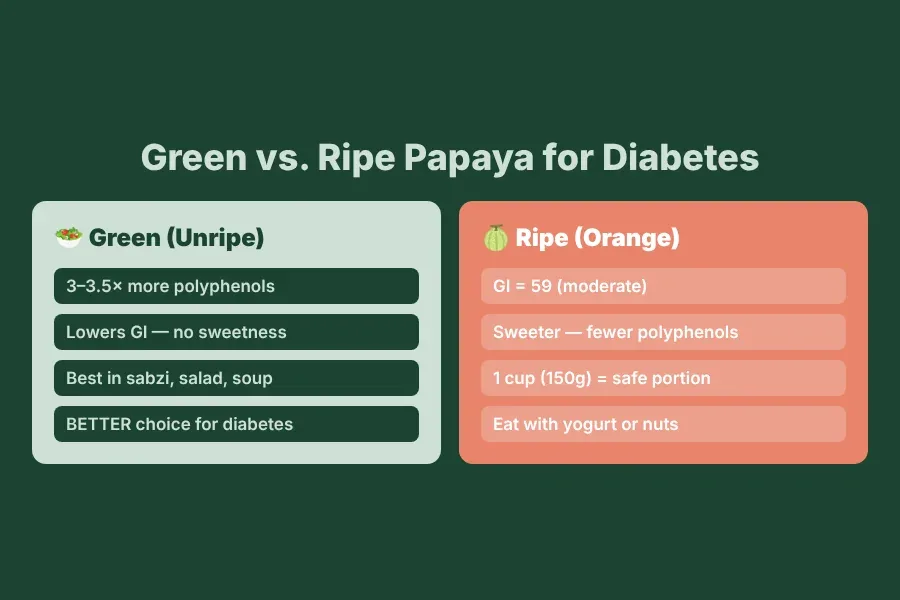
Almost no article on papaya and diabetes addresses this, but it matters for how you use the fruit.
Green (unripe) papaya is the papaya used in Thai green papaya salad (som tam), in Indian kachchi papaya sabzi, and in many South and Southeast Asian preparations. It has a firm texture, almost no sweetness, and is typically cooked or eaten as a vegetable rather than a fruit.
Based on available research, green papaya:
- Has higher concentrations of kaempferol, quercetin, and trans-ferulic acid
- Stimulates glucose uptake more potently in cell studies (3–3.5× vs. ripe)
- Has lower sugar content (less ripeness = less fructose formation)
- Has a lower estimated GI than ripe papaya
Ripe papaya is the soft, orange-fleshed fruit eaten as a dessert or breakfast fruit. It is sweeter, lower in polyphenol content, and has the moderate GI of 59.
For someone managing diabetes who wants to include papaya regularly, green papaya in savory preparations (sabzi, salad, soup) is likely the better choice than ripe papaya as a sweet snack — both because of the polyphenol profile and because it is less easy to overeat in a savory context.
How Papaya Compares to Other Common Fruits
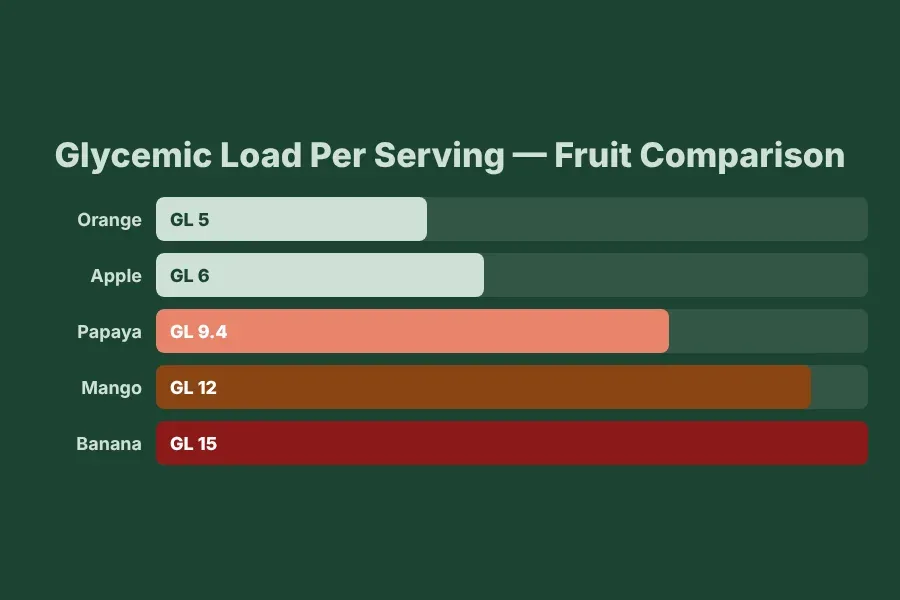
| Fruit | GI | Typical Portion | GL per Portion |
|---|---|---|---|
| Ripe Papaya | 59 | 1 cup (150g) | ~9.4 |
| Apple | 38 | 1 medium (182g) | ~6 |
| Mango | 55 | 1 cup (165g) | ~12 |
| Banana (ripe) | 62 | 1 medium (120g) | ~15 |
| Watermelon | ~72–76* | 1 cup (152g) | ~8 |
| Grapes | 59 | 1 cup (92g) | ~11 |
| Orange | 45 | 1 medium (131g) | ~5 |
*Watermelon GI is debated in the literature — some sources cite values as low as 72, others higher. Best eaten in small portions.
Papaya sits in a reasonable middle ground — lower GL than banana or mango per portion, higher than apple or orange. It is comparable to grapes.
The Papain Question
Papain is a proteolytic enzyme present in papaya, concentrated in the skin and seeds but also present in the flesh, particularly in unripe fruit. It breaks down proteins and has well-documented anti-inflammatory properties.
The connection to diabetes management is indirect: chronic low-grade inflammation is a driver of insulin resistance and beta-cell dysfunction in Type 2 diabetes. Anti-inflammatory compounds that reduce this background inflammation could, theoretically, support better glucose regulation over time.
For most people eating a normal portion of ripe papaya, the practical implication is minimal — papain content is low in ripe flesh and your body digests it largely before it reaches systemic circulation. The relevance of papain is more significant if you are using green papaya regularly or consuming papaya skin preparations.
⚠️ Important: Drug Interaction Warning
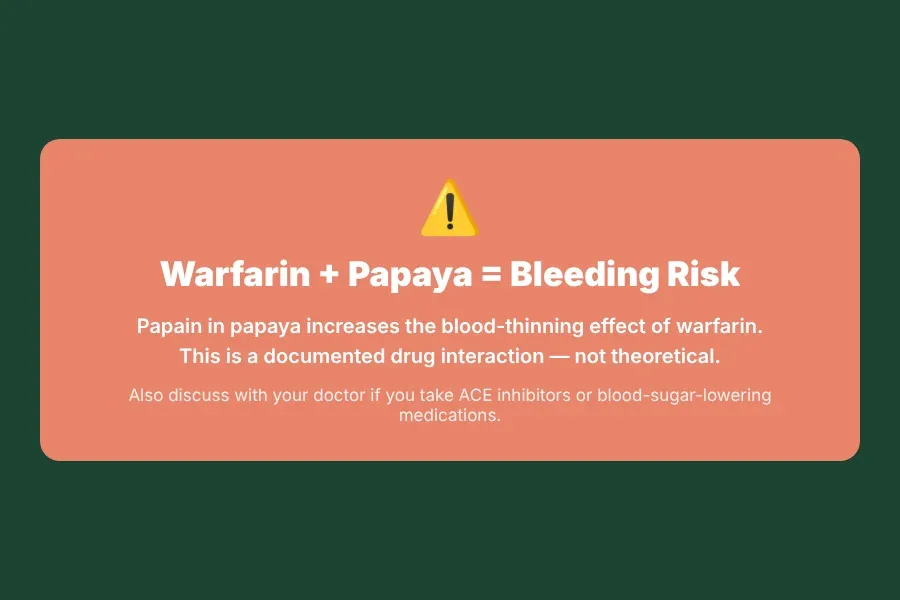
If you are on warfarin (Coumadin) or any other anticoagulant medication, speak to your doctor before eating papaya regularly.
Papain has documented anticoagulant properties. Combined with warfarin, it can increase bleeding risk. This is not a theoretical concern — it is an established drug interaction that appears in pharmacological reference literature. The risk applies particularly to green papaya, papaya seed preparations, and high-frequency consumption of ripe papaya, where cumulative papain intake is higher.
Other people who should discuss papaya intake with their doctor before making it a regular part of their diet: those on ACE inhibitors or diabetes medications that already lower blood sugar, where the additive effect on glucose could be relevant.
How to Eat Papaya with Diabetes: Practical Guidance for an Indian Kitchen
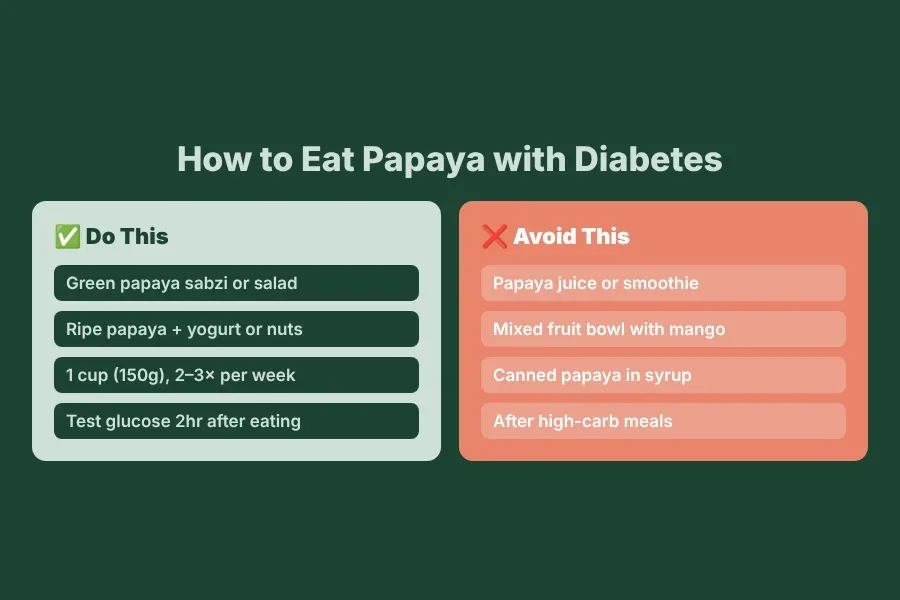
Portions that work:
- 1 cup (150g) of ripe papaya, 2–3 times per week
- Individual glucose responses vary — test with your glucometer 2 hours after eating
India-specific preparations that are diabetes-appropriate:
Kachchi Papaya Sabzi (Green Papaya Stir-fry)
Cook grated green papaya with turmeric, cumin, and minimal oil. High polyphenol content, low sugar, high fiber. This is the most diabetes-friendly papaya preparation.
Green Papaya Salad (Kachumber style)
Grated green papaya with lemon, green chili, coriander. No cooking required. Low calorie, high in fiber and polyphenols.
Ripe Papaya with Dahi (Yogurt)
A small portion of ripe papaya with full-fat dahi. The protein and fat in yogurt blunt the glycemic response. Better than eating papaya alone or with other fruits.
What to avoid or limit:
- Large fruit salad bowls combining papaya with high-GI fruits (mango, chikoo)
- Papaya juice or smoothies (removes fiber, concentrates sugar)
- Canned papaya in syrup
- Papaya after a high-carbohydrate meal when cumulative load is already high
The Bottom Line: Is Papaya Good for Diabetes?
Yes — with the right portion and context, papaya is a reasonable inclusion in a diabetes diet.
The GI of 59 is moderate, not low, but a one-cup serving produces a low glycemic load (~9.4). The research on papaya’s anti-diabetic mechanisms is promising at the cell and animal level, with limited but suggestive human data. The green versus ripe distinction is real and meaningful: if you want to use papaya therapeutically rather than just as an occasional fruit, green papaya in savory preparations is the better choice.
GI alone does not determine how papaya affects your blood sugar. Portion, preparation, what you eat it with, your medication, and your individual metabolic response all matter. Your glucometer tells you the truth about whether a specific portion of papaya works in your specific context — and that data is more directly useful than any general guideline.
If you are managing diabetes and want help building a fruit-inclusive meal plan that accounts for your individual glucose patterns, our diabetes meal planning guide is a good place to start. For a broader view of how to eat for blood sugar control in an Indian dietary context, see our guide on diabetes-friendly Indian meals.
References
- Okafor, J.N., et al. (2023). Polyphenolic compounds of Carica papaya improve glucose uptake in insulin-resistant skeletal muscle cells via IR/GLUT4 signaling. Nutrients, 15(8), 1953. https://doi.org/10.3390/nu15081953
- Roy, J.R., Janaki, C.S., Jayaraman, S., Periyasamy, V., Balaji, T., Vijayamalathi, M., & Veeraraghavan, V.P. (2022). Carica papaya reduces muscle insulin resistance via IR/GLUT4 mediated signaling mechanisms in high fat diet and streptozotocin-induced Type-2 diabetic rats. Antioxidants, 11(10), 2081. https://doi.org/10.3390/antiox11102081
- Atkinson, F.S., Foster-Powell, K., & Brand-Miller, J.C. (2008). International tables of glycemic index and glycemic load values. Diabetes Care, 31(12), 2281–2283.
- Somanah, J., Aruoma, O.I., Gunness, T.K., Kowelssur, S., & Bahorun, T. (2012). Effects of a short term supplementation of a fermented papaya preparation on biomarkers of diabetes mellitus in a randomized Mauritian population. Preventive Medicine, 54(Suppl), S90–S97. https://doi.org/10.1016/j.ypmed.2012.01.014
Written by Kirti, Founder & Serial Entrepreneur, HealthyWayFit. Last updated: October 2026.
This article is for informational purposes only and does not constitute medical advice. People managing diabetes should consult their healthcare provider or a registered dietitian before making dietary changes.



